The Coblynau of Cymru- The Welsh mine faeries

One of the Welsh coblynau

Here I’m continuing the theme of mine-dwelling faeries, but with our attention shifted from Cornwall to Wales. The Welsh Tit-Bits feature in the Cardiff Times for Feb 20th 1909 featured a long ‘Miner’s Tale’- a piece that purported to be a very tragic personal account recorded after a chance conversation in a pub:

“You must know,” said the miner to the stranger, that there inhabit our mountains certain invisible beings, which are called in Wales Tylwyth Teg, or knockers. These genii live underground- in or near mines; you may haply laugh at our simplicity in maintaining the existence of such spirits, but you will not meet with any person conversant with our employment who does not believe that they are pre-indicators of mines and by their noises point out to the workmen the veins of ore of which they are in search, as visions in dreams are the precursors of prizes in the lottery and other accidents that occur to us.

But not to account for one phenomenon more than another, all I can say is that there are plenty who will speak well of the knockers because they have stood good friends to them- but, for my part, all I know is they proved the ruin of me. There was a time indeed when I was as incredulous of them, as I see by your face you are, and deemed it a mere popular superstition, and have often thought that it might be in vengeance for my want of faith that they leagued against me, with the aid of an old hag [a gwrach or witch]. Whether that be so or not, who can tell ? But I for a long time shut my ears to her reports of their nightly meetings at the foot of one of my hills. As I was amusing myself one evening with my rod and line (for then I was a gentleman like you) on the River Mynach adjoining my grounds… I chanced to meet with old dame Cadwaladar, as she called herself, picking up toadstools on the bank of the river. These, I suppose, she required for compounding her poisons. Accosting her, I laughed at her stories about the little folk of the mountain- the Tylwyth Teg. She was not, however, to be put out of countenance, nor so easily foiled, for she described to me the nature of the noises she had heard, and always at the same place, and at the same hour of the night, though there was no mining going on at that time within miles and miles. To hear her talk one would certainly think she must have dealings either with these spirits (who are said to be harmless) or with some infernal powers, for she brought forward an instance in support of her argument that might have convinced the most sceptical. There was a deaf and dumb tailor in the village, who had a particular language of his own. From practice I could understand him, and he me, by motions of the fingers, hands and eyes. ‘Now,’ argued the beldam, ‘if this man had really seen one in the bottom of a sink of water in a mine, and wanted to tell you how to get at it, would he not set up two sticks like these set for a pump and go through the motion of a pumper at the sink where he knew that the ore was, and then imitate the wheeling of a barrow?’ What would you infer from these signs but that he wanted you to pump and drive and wheel the rich stuff out.in the very place where he had seen it? By like, reasoning, the language of the Tylwyth Teg signifies that you should do the same where I heard the noise, or the sounds. She saw that she had made some impression on me and shortly practised another imposition on me with much more success. The natives of Cardiganshire have an equal faith in the divining rods. They are made of hazel… [and] the witch pretended with one of these divining rods or wands to have discovered the precise spot where the matrix of ore was…

My tranquillity of mind was now gone. I neglected farming, took no longer any pleasure in angling, was indifferent to the caresses of my children, and behaved harshly to my wife, to whom I had been until then devotedly attached. Dreams made up the better part of my existence, and my eyes gloated nightly in visions of heaps on heaps of glittering metals, and my ears were filled with the rolling of barrows, the pumping of water, and the hammering of the spirits… The place pointed out by the hazel twig, as my Eldorado, was Glyn Clwyd, and the neighbouring mine having been abandoned, and all the workmen who had been employed there out of work, I immediately hired them, and set to work in real earnest… In the evening, after the men had left, I went into the shafts to listen for knockers, and often stood there till midnight listening, but the little people had forsaken their haunts, or, out of spite, suspended their labours… Acre after acre, one by one, did I squander in this mad and hopeless undertaking… till at last I sold my house and all the remainder of my farm… This done I moved to a cottage near the shaft, the better to superintend the work. But why continue my narration ? The story of my madness- no, that you cannot know, but already must have divined my ruin. You see it exemplified in myself- you know what I was, you can see what I am now. Ere long I was penniless. My wife died of a broken heart, my children reduced to beggary, and the long shaft of Glyn Clwyd is called to this day, Owen’s Folly- an eternal monument and record of my shame.”

The belief in the knockers and their predictive powers existed right across Wales- from Flintshire in the north down to Cardiganshire (Ceredigion) in the South West. The earliest recorded report we have is from November 1656, when a John Lewis of Glascerrig in Ceredigion mentioned the mine sprites in a letter, “little statured, about half a yard long,” and said that- at that very moment- miners on his land were following the sounds of faery digging in pursuit of a rich vein. Four centuries later, in 1883, they were reported still to be working at Talargoch lead mine in Flint, pursuing lodes across the countryside. They were also mentioned on Anglesey (Ynys Mon) in 1908 and, in late 1897, the folklorist Rev Elias Owen gave a talk at Chirk and reported how older miners would claim to have heard the knockers hundreds of times; they had no fear of them, as their evidence of their proximity was a welcome sign that ore (or coal) was also nearby.

Lewis Morris, the owner of Esgair Mwyn lead mine near Ysbyty Ystwyth in Ceredigion in the mid-eighteenth century, attested that they had guided him to rich seams of ore and then ceased their work: “I must speak well of these knockers, for they have actually stood my very good friends, whether they are aerial beings called spirits, or whether they are a people made of matter not to be felt by our gross bodies, as air and fire and the like. ” He called them “a kind of good-natured, impalpable people, but to be seen and heard, and who seem to us to work in the mines… a harmless people who mean well.” Morris also mentioned in a letter of November 1754 that “the knockers (a kind of subterraneous Spirits…) have a language which we as yet don’t thoroughly understand, but, as we understand Dumb Men by Motions, though we hope to come to it by and by…” (Y Cymmrodor vol.49 Part 1). This is one of several reports of the language of the Welsh faeries that make it clear that it was no more comprehensible to Welsh speakers than it was to English.

Furthermore, Lewis Morris was at pains to stress to his correspondent that “an abundance of sober honest people” had heard them; in other words, what he wrote was serious and mature and not the babbling of a child but the level-headed report of a sensible business man. Coincidentally, the tragic tale told at the start by the ruined Mr Owens also came from Ceredigion, being heard at an inn at Pont-rhyd-y-groes near Hafod, a little further north of Esgair Mywyn. When Owens spoke to the writer, he regretted his actions, but it is plain that- at the time he was pouring money into the mine based on the evidence of the knockers’ activities- there would have been many in the community who considered him perfectly rational to do so.

The North Wales Chronicle for 1875 confirmed continuing belief in the knockers, “subterraneous spirits whose province is the mineral kingdom, and whose busy working or knocking in the most remote parts of the mines was wont to draw the attention of the workmen to the richest veins of ore. Fitful and capricious these knockers were said to be, like most other ‘little folk,’ but not to the trustful, believing, and honest-hearted seekers. The covetous and over-reaching, or otherwise selfish workman, they might rather enjoy leading astray, but living folk will tell you that some of the finest mines in North and South Wales have been discovered by the diligence with which these busy sprites bore and blast, and ‘beat down the loose’ with their hammers and that it needs to humour their dignity and tenacity by accepting their hint, and following their indication without interruption of work or idle remarks, or they will stop off-hand and take offence.”

As we have seen, the knockers were variously described and labelled; they were also called ‘tappers’ and, amongst native Welsh speakers, the English word could become ‘knockiwrs,’ whilst another name was simply esprid y mwyn (mine spirits). One report termed them a “species of aerial beings”- an odd phrase for underground labourers- and they were also described as impalpable spirits- once again, strange terms for beings engaged in such strenuous physical labour. As we’ve seen, they were frequently classed as part of the Tylwyth Teg, the fair family of faeries- hence, one writer in The Cambro-Briton in May 1820 said they were “good-natured… highly respected and are deemed nearly allied to the Fairies.” They were also called coblyn (singular) and coblynau (plural)- which is no more than ‘goblins’ in Welsh. The word may, in turn, be related to the German kobold, a name applied to the brownie-like sprites that inhabit mines there.

Referring back to my last post, the Welsh coblynau shared all the traits of the Cornish knockers: they were generally helpful and kind, but could react adversely at any suggestion of greed or ingratitude. Whilst “generally harmless,” they had to treated with respect and caution. As the narrator of the first account suggests, his want of belief- and then his all-consuming desire to get rich, at the cost of his family’s happiness and welfare, could very well have alienated the mine faeries.

Going off on a fascinating and curious tangent, one Welsh newspaper compared the knockers/ coblynau to the underground people in Bulwer-Lytton’s novel of 1871, The Coming Race. Not knowing the book, I followed it up in case it was a folklore source. In fact, it was much stranger: it is the story a subterranean master race, the Vril-ya, who wield the energy-form called ‘Vril.’ This word caught on in strangely opposed ways. In Britain, the name was harmlessly applied to the beef drink Bovril to suggest the power of the ox (from the Latin bos/ bovis) that might be derived from drinking it. However, the book’s ideas of a homo-superior also evolved into the regrettable Aryan theories of the Nazis and led to the foundation of a Vril Society, female members of which grew their hair very long so as to communicate with aliens…

Returning to the coblynau, what I think unites us with this particular tribe of the Good Neighbours is the shared peril experienced by humans and faeries underground. For miners, they appreciate the sense of companionship and sympathy, the understanding of the conditions, the risk and rewards, that can only come from working in proximity in extreme conditions. Whilst the coblynau are not beyond tricks and revenge, mortals identify with them and take comfort from their presence more than with any other group of the Good Folk; with the knockers, that epithet is genuine.

If we but knew what the Knockers know…

In March 1922, the Devonian and Cornish newspaper the Western Morning News carried an article on miners’ superstitions. The author, John Lavington, explained that the West Country mines are inhabited by sprites called Knockers, beings who are akin to brownies and pixies and are “little withered, dried up creatures about the size of children a year old, with heads disproportionately big for their bodies, ungainly limbs and squeaky voices.” The link with the pixies/ piskies is commonly made, as these beings inhabit the same area and are very likely to be related. The comparison with brownies is unusual, but may derive from the fact that knockers undertake the same work as humans and will assist with it (as we shall see), sharing mines with men just as brownies share our farms.

The journalist offered an explanation of their origins that is rather typical of this part of the world: they were alleged to be Jews who, for calling on the Romans to execute Jesus, had been banished to deep mines. I can’t help feeling that this is more of a sign of Wesleyan influence in the Cornwall than any truly deep-rooted origin myth. Furthermore, why Cornish mines particularly were chosen, we’re not told.

What’s far more interesting to me about Lavington’s account- a feature which also seems to me to be far more likely to be authentic and ancient local tradition- is the belief he reported that the actions of knockers are prognostications. They are a noisy people- seldom seen, admittedly- but regularly heard, and the sound of their borers and barrows, the fall of rocks they’re excavating and the “chink of ripe ore” (a sound recognisable and highly desirable to miners for obvious reasons) were all familiar to the miners and were understood to be meaningful.

Lavington told the story of a worker at Wheal Rodney (about half a mile inland from Marazion) who heard some drill bits being dropped in a long-deserted sett, or working, a part of the mine that was considered to have been exhausted. He went to investigate and, despite the fact that the sett had been abandoned ages ago, decided to try digging there- and quickly found a rich new lode. In another case, a man heard a sound like mined ore being poured from a sack. He was on his own, but the sound appeared to emanate from a shaley piece of rock nearby, so he pulled at it- and lumps of copper ore “like cinders” fell out. Plainly, the knockers know what they’re doing and want to share it with us.

Cornish miners had long understood that the knockers had geological knowledge exceeding ours and, accordingly, they would habitually give up a portion of their lunches to them, hoping that they would then be led to the best lodes of tin and other metals. This might be done by means of the sounds of excavating, as we’ve read, but it’s said to be general indicator of good luck if they’re seen dancing in the adit (the entrance passage way) of a mine.  What’s more, the knockers will warn of impending disaster underground, saving the miners as well as enriching them. 

As ever with the supernatural folk, there’s a balance to be struck. They can be averse to humans being too inquisitive, so even though the sounds of their work indicate how and where to dig, if miners stop their work to concentrate on listening to the knockers, they will also cease their labours in response.  If a man accidentally comes across the knockers, they will very soon disappear. Equally, those who offend them will be punished and those who betray the source of their good fortune can be sure to lose it. Punishment could be delayed, though, sometimes falling on later generations; unjust as that may seem to us, it is a common faery trait. Miners who were mean- and didn’t share their food- could also expect to stay poor, or to lose any benefit the knockers may have brought them.

There’s a strange love/hate- tolerate/abhor relationship between all faeries and humans. It takes particular form with the knockers, shaped by the environment they share with the mortal miners. They appreciate the risk of underground labour, and can take sympathy on us and protect us from harm, but- as ever, there seems to be a limit as to just how much they’re prepared to put up with from us.

Draw the blinds against the faeries- the fatal faery look

Just an ordinary day in Brighouse, West Yorkshire (from examinerlive)

In early August 1891 the St James Gazette, a London evening newspaper, published a small piece on the guytrash or barguest, the eerie creature known to haunt the West Riding of Yorkshire in particular. At night, it would walk along the tops of walls, dragging chains behind it, or would pass around between houses, looking in at windows; in response, the residents would “draw their blinds to avoid its eyes.” This is the feature of the guytrash (or gytrash) that I wish to highlight and discuss here.

Many faery beings have alarming eyes, sometimes merely large, frequently also glowing red. Amongst these may be numbered the water bulls of the Isle of Man (the tarroo ushtey), the Highland each uisge and njugl, the Brown Man of the Muirs known on the Scottish Borders, certain padfoots, shucks and boggarts and- especially- many of the black dogs that haunted the east of England. These features are clearly a key constituent of these beings’ ghastly and terrifying appearance. There is more to their eyes than that, though, as the 1891 implies.

The Hedley Kow, known at Hedley in County Durham, had many malign tricks, one of which was to stare in at farmhouse windows, tormenting women inside whilst they were in labour. In the Highlands of Scotland, the corra-loigein was described by John Gregorson Campbell in 1902. It is a kind of bodach, a local type of ‘nursey bogey’ who “looks in at windows, flattens his face against the panes, sharpens his teeth with much noise, and takes away children in a twinkling, unless they keep quiet. Neither he, however, nor any of his brother bugbears, enter a house unless called in.” This may well be part of the reason by the people of West and South Yorkshire were reported to be so desperate to avoid the gaze of the guytrash at their windows: it was not just alarming, but perilous. Tommy-loudy, a loud blustering goblin in the Holderness district on the East Yorkshire coast is very similar; he shakes the window-panes, whistles and moans through the lattice, and scares children with his noise.

Faery eyes can be more dangerous still, though. The Highland kelpies are known for their staring eyes. The deadly kelpie of Pot Cravie (Poll nan Craobhan) on the River Spey, trapped its victims with its gaze. Anyone who approached, thinking to ride the horse, would be frozen on the spot by a glance from the kelpie’s fearsome eyes; subdued, they could then be carried off into the river, where they would be devoured.

The black dog of Trowler’s Gill in Wharfedale in North Yorkshire is similar.  If you stare into its huge yellow eyes, you are certain to die within days.  Black dogs are a species of apparition that are notoriously dangerous; merely seeing or hearing them can make a person seriously ill or prove fatal (or predict the death of another). Even seeing them, though, can be a deeply distressing experience, for another common black dog habit is to fix an unfortunate person with those glowing red eyes and then to hold them in its unwavering gaze, shuffling backwards in front of them as they try to make their way home, never breaking eye contact with the victim. As you can imagine, this enough to send anyone to bed for a couple of days after the finally have made it to their destination.

It is not unusual to read about faery eyes being unusually bright or strangely coloured. Their deadly quality, or their ability convey maleficent magic, is something which is far less remarked upon, but is consistently present in the folklore.

Faery Music- live in Oslo!

For any readers who happen to be in Oslo on September 18th at 6pm, you have the chance to attend the premiere of Fairies, by Signe Heinfelt, who’s a Danish composer living and working in Norway. As the venue, Den norske filmskolen, describes the new work- “Composer and sound artist Signe Heinfelt delves into the auditory world of English folklore and fairy superstitions, intertwining myth with the natural soundscapes of South West England.”

Why am I alerting you to this? Because this event marks the fruition of a protracted project by Signe, which for me began in April 2020 with an e-mail from Simon Young of the Fairy Investigation Society, asking if I’d like to assist her. Signe was looking for guidance. She had had an idea to “compose a track for fairies, and one for trolls. The fairies being the small Tinker Bell winged miniatures… imagine how could it would be, having an audio experience of small fairies flying around you.” She did some reading (Katharine Briggs, the FIS site and other sources) and revised her views: she had become “interested in more evil, darker fairies. However I intend to focus mainly on the female ones – and those on land/air.” The musical project had formed more clearly in her mind: “I am exploring the sound of fairies. Fairies have been interpreted in visual art by many artists- but how do they actually sound? To find out I have decided that I will travel to U.K. and Ireland and record the sound of places where there have been fairy sightings. To do actually field recordings of those places… Devon, Cornwall, the Scottish Highlands…”

So, Signe needed help deciding which places to visit in England and Wales. We spoke over Skype and corresponded by e-mail and discussed various potential locations around Britain. Matters were, of course, complicated by Covid and lockdowns and by the fact that, in the more remote rural areas of the country, our public transport is rather poor (unlike Norway, it appears). Because of travel restrictions, the visit had to be postponed until 2021 and, because various study grants were not forthcoming, the trip had to be limited in scope. Eventually, with some financial assistance having been made available, Signe was able to travel in May 2022 and to conduct recordings in two places. The first was at the Fairy Gump, outside St Just in the extreme west of Cornwall, where a man saw once a pixie revel (with music), tried to steal their gold and was punished. The second was at Cottingley, West Yorkshire, home of the famous sightings during and after the First World War.

The story of the Fairy Revels on the Fairy Gump is set on an area of largely level ground just outside the far Penwith mining village of St Just. The original name for the area, an woon gumpas, the level downs, has been abbreviated to ‘The Gump’ (the level), which is oddly inappropriate seeing as we’re dealing with a typical faery hill or knoll. This spot was renowned as an assembly place for the local pobel vean (little folk), where they feasted and danced. Respectful visitors were tolerated, and allowed to watch the festivities; some even received small but precious gifts. One greedy old man thought he could do better and aimed to steal as much as he could. He therefore climbed the Gump one full moon and, in the words of Robert Hunt in Popular Romances of the West of England:

“At length, when he had not advanced far on the Gump, he heard music of the most ravishing kind. Its influence was of a singularly mysterious character. As the notes were solemn and slow, or quick and gay, the old man was moved from tears to laughter; and on more than one occasion he was compelled to dance in obedience to the time. Notwithstanding that he was almost bewildered by the whirling motion to which he was compelled, the old man ‘kept his wits awake,’ and waited his opportunity to seize some fairy treasure ; but as yet nothing remarkable had presented itself. The music appeared to surround him, and, as he thought, to come closer to him than it was at first; and although its sound led him to believe that the musicians were on the surface, he was impressed with an idea that they were
really beneath the earth Eventually there was a crash of sound, startling beyond description, and the hill before him opened.”

Out trooped a huge band of the little people, including “an immense number of musicians playing on every kind of instrument.” A banquet was laid out for the faery court and it was at this point that the man tried to make his move and grab as much of the gold and silver tableware as he can. Of course, his actions had been predicted and he was bound with cobwebs and left immobilised on the ground as dawn came and the faeries vanished. Interestingly, Hunt calls them spriggans in this tale, beings whom he distinguished from both the pobel vean and the piskies. The spriggans are, he suggested:

“quite a different class of beings. In some respects they appear to be offshoots from the family of the Trolls of Sweden and Denmark. The Spriggans are found only about the cairns, quoits or cromlechs, burrows, or detached stones, with which it is unlucky for mortals to meddle. A correspondent writes :
” This is known, that they were a remarkably mischievous and thievish tribe. If ever a house was robbed, a child stolen, cattle carried away, or a building demolished, it was the work of the Spriggans. Whatever commotion took place in earth, air, or water, it was all put down as the work of these spirits. Wherever the
giants have been, there the Spriggans have been also. It is usually considered that they are the ghosts of the giants ; certainly, from many of their feats, we must suppose them to possess a giant’s strength. The Spriggans have the charge of buried treasure.”

Whatever label we want to apply (and I’m not sure myself that there is any clear division into different species or tribes) their behaviour was perfectly typical of any faery being: protective of their own goods (quite reasonably), prepared to punish those who offend or trespass against them- and musical. The music heard at the Gump resembles many, many accounts that we have from across Britain. Instruments are very commonly reported (such as drums, bells, fiddles and pipes), although they may vary regionally, from bagpipes in Scotland to harps in Wales.

Especially typical, though, are two elements of the account. Firstly, there’s what Hunt termed the “singularly mysterious character” of the tunes. Their mood seemed constantly to shift and their emotional impact upon the old human similarly was similarly changeable, unpredictable and uncontrollable. Secondly, there was the difficulty of precisely locating the source or exact nature of the music. This has been regularly described by witnesses; faery music often sounds “unearthly” and impossible to compare with human tunes; even more, it can seem to come out of the air itself- as the miser reported, giving the impression of surrounding him on all sides. The combination of aethereal beauty, unfamiliar patterns and forms, and an almost immersive quality, is what has typified numerous reports over the centuries. The story of the Fairy Revels on the Gump is, therefore, an excellent encapsulation of many of the features of the sometimes bewildering, sometimes uplifting, experience of encountering faery songs and tunes.

Now, whilst I have written several times about faery music, but I have neither heard nor, certainly, recorded it; nor have I composed on faery themes- unlike Signe or Rutland Boughton– or many others, both classical, rock and contemporary. What the performance of Fairies in Oslo particularly underlines is a fact that, I think, can’t be stressed enough: how influential the faery faith has been upon our culture and- perhaps surprisingly- how it continues to shape the arts- both popular and fine- today.

Mermaids: love matches, mothers- or monsters?

The Scottish story of The Fisher and the Grey Lad is concerned with mermaids which, as we are told at the outset, are well known to be ” sea-monsters, half-woman, half-fish, with long yellow hair which they comb when they sit on the rocks to bask. They are very fond of music, they are very rich, and they are able to do many wonderful things. They often endow men and women with magical powers, and sometimes they fall in love with land people and marry them.” Some of this description may be familiar: we know about their looks and vanity, of course; their liking for music, shared with the wider faery folk, may be new but is readily understandable, as is the case with magical powers and their susceptibility to falling for humans (and vice versa). For men and women, the allure of supernatural lovers has always been the fact that they are uninhibited by many of the moral scruples that afflict humans, so that they can seem like much more exciting and liberated partners. The truth is, though, that these partnerships seldom last. Love across the divide between the supernatural usually proves fragile; whether it is that the mermaid longs for her own kind or one spouse abuses or offends the other (sometimes by unwittingly breaking some taboo that is a condition to marriage, as with the Welsh lake maidens, the gwragedd annwn), even the bonds of maternal love for the pair’s offspring will not be enough to keep her on land.

The description of mermaids as sea-monsters may strike us strange and excessive, but it reflects a distinct strand of British folk belief. They may be humanoid, but they are not like us; as a result, they can be dangerous- if not fatal, for their partners. Dragging lovers to their deaths under the waves is not uncommon, but- as this Scottish account reveals- it can be worse still than that.

The hero of the tale of The Fisher and the Grey Lad, Duncan, had no luck fishing and so promised to a mermaid, in return for her help getting plenty of fish, his youngest son. This promise was broken for, after many adventures, the fisher’s son was instead married to the king’s daughter. One day she wanted dulse and asked the lad to go with her to the strand to seek it. The lad forgot his promise to his father not to go near the sea, and went together to the sea-shore. Whilst they were wandering and gathering dulse amongst reefs and stones on the ebb, the cheated mermaid rose from the waves, saw the lad and made a rush, shouting: “It is many a day since you were promised to me, and now I have you”- and she swallowed him up alive.

[The mermaid as a kind of cannibal lover is a startling new element in this tale- but is not unknown, as the Scottish kelpies and each uisge confirm. Unwary lovers are often chosen purely for the purposes of being able to destroy them and to partly devour their bodies. I have also described in the past the vampire faery beings of the Highlands; the glaistigs and others will prey on young people, seducing them in the guise of attractive partners before drinking their blood. Suffice to say, the faery folk of northern Britain can be far more vicious than anything known in English tradition.]

To return to The Fisher and the Grey Lad, the bride fled, weeping and wailing back to the castle where the counsellor was, to ask his aid. He advised her to go down with all her dresses and jewellery and to spread them out by the sea-shore. Then she was to pick up her harp and play. She did as advised and had not sat long there playing in the dark when the mermaid rose outside the surf, for mermaids are fonder of music than any other creatures, and there she floated, listening ; but when the king’s daughter saw the mermaid, she stopped.

“Play on,” said the mermaid. “No,” said the princess, “not till I see my man again.” So the mermaid opened her great mouth and gaped, and showed the lad’s head, and the king’s daughter knew that he was alive. “What fine things you have there!” said the mermaid, as she swam close to the shore. “Yes,” the princess replied, ‘I would give them for my husband.” “Well, then, play on,” said the mermaid. So the lady sat on the green mound and played, and the mermaid lay in the brown sea-ware and listened, and opened her mouth and gaped, and showed the lad to the waist, and swallowed him down again. Then the lady stopped again, and the mermaid repeated: “What fine things you have there on the rocks !”
“Yes,” said she, “I would give them all for my husband.” “Well, then, play on,” said the mermaid.

So the lady played on, and the mermaid rolled amongst the brown seaweed and opened her mouth once more and took out the lad altogether, and placed him upon her open palm – and he, once he was free, thought of a falcon, and he became a falcon, and flew and darted to shore, and was free. Now, when the mermaid saw that her prey was gone, she made a snatch at the wife and took her away instead. When the lad saw that the mermaid had taken away his wife, he was wild with grief, and mad with rage, but did not know what to do, so he went to the counsellor and asked his aid. “ Well,” said the counsellor, “there is but one way to win your wife, and that is to take the mermaid’s life.” “And how is that to be done ?” said the lad. “The mermaid’s life,” said the counsellor, “is not in her body, and so it is easy to take. It is in an egg, which is in a fish, which is in a duck, which is in a ram, which is in a wood, under a house on an island, in a lake.”

Readers of Harry Potter will recognise this idea. It is the motif of the ‘separable soul,’ a common element of folklore (and not invented by J K Rowling) and, of course, the fisher boy is able to find the concealed soul, destroy it, recover his wife and live happily ever after. The ‘external soul’ appears mainly in stories from the Highlands, such as that of Green Sleeves in Ancient Scottish Tales. The mermaid of the Fisher and the Gray Lad is doubly remarkable, therefore: she is both a sort of sea-serpent and she is has the kind of magical protection from slaying usually only seen amongst wizards and giants.

Peter Blake- Ruralist & Fairy Artist

Blake, Titania, 1984, MMA

Some years ago, I wrote a post on the faery paintings of Peter Blake. Further reading on his work inspired me to return briefly to this subject. Blake’s interest in British faery-lore emerged strongly during the early 1970s when he was one of the ‘Brotherhood of Ruralists’- a group of artists inspired (in part) by the Pre-Raphaelite Brotherhood and the landscape tradition of British painting as represented by groups such as Samuel Palmer and the Ancients. Other artists in the Brotherhood who worked on faery and imaginative themes include Graham Ovenden, who had a general interest in Victorian faery art and stories; the pair collaborated together on painting scenes from Carroll’s Alice stories as well. Literature was a significant source for much of the Ruralists’ work: hence Blake’s images of Shakespeare’s faery queen Titania and Puck (see the last post) or their series of paintings of Ophelia. These interests were compounded by the artist’s own experiences of fatherhood (his first daughter was born in November 1968) and his growing appreciation of the powers of the childish imagination and of storytelling and that these could be visual as well as verbal.

Peter Blake, Babe Rainbow

Blake’s background and artistic interests were far more urban and contemporary. Much of his earlier work- often classified as ‘Pop Art’- dealt with popular culture: wrestlers, strippers, rock and roll stars and childhood obsessions such as collecting badges and going to Saturday matinee cinema. After he moved back to London, during the 1980s, Blake visited Los Angeles and painted modern city life there. His pictures of Titania and other faery girls therefore seem to sit rather uncomfortably with these kinds of work.

Blake, Titania (1972-74)

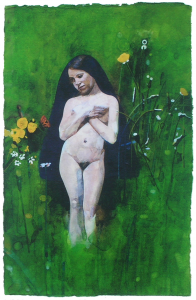
Nonetheless, there are clear links between the faery paintings and Blake’s interests before and after. One is the simple, frontal pose his figures so often adopt: you see it in his pictures of circus performers, film stars and pin-ups just as much as in his early portrait of Titania (1972-74) as well as in nudes like Fairy. The full lips and bog eyes are typical of many of the artist’s portrait studies, but he progressively became more adventurous in his treatment of the faery world.

Peter Blake, Fairy, Falmouth Art Gallery

All these figures share, too, the powerful ingredient of sex. Blake brought to the world of faery an adult knowledge of sexuality and the resultant combination of eroticism and innocence is what makes images like his Titania so effective. Of course, whilst the fairies that may have fascinated his daughters Daisy and Liberty were untroubled by such concerns, regular readers will know that British faery tradition is steeped in sex and desire. Of his adolescent Titania (painted 1976-83), he told the BBC in an interview that “I wanted to feel how the Queen of the Fairies might feel and what she might do. I’m trying to invent a morality. One concept was that she might not cover the important parts that a mortal might cover, so she might well decorate her breasts and her public hair” (with lengths of knotted grass). This later faery queen is an interesting combination of natural innocence and, as Natalie Rudd observed in her Tate Gallery study of Blake’s work, a move away from the “childlike asexuality” of earlier faery studies to something akin to classical nymphs and Blake’s own pictures of strippers and female wrestlers; Titania is “a figment of male fantasy, poised eternally between innocence and desire, childhood and womanhood, apparently available yet essentially out of reach” (Rudd, 2003).

Blake, Titania’s Birthday, 1975

Blake’s faeries are full of paradox for us. His Fairy with Toadstools, of about 1977, is based on a photo of a busty glamour model- yet the fungi around her show she’s barely a few centimetres tall. The adolescent Titania is about half adult size and the Fairy in Falmouth Art Gallery is similar: she’s scarcely taller than the wild flowers in the meadow where Blake sighted her; what’s more, her exact age is indeterminate- she’s both child and adult (by human standards, anyway). She too is miniscule, so that the luxuriant hair which sweeps the grass behind her is just a few inches in length. Compare her also to the nude figure in the foreground of his large 1969 painting Puck or to the tiny, twisting nude figures that surround his naked Titania: eroticism seems latent in Faery, even if it exists in a dimension beyond our reach. That said, some of his faeries have human dimensions: their reality is mutable, it seems.

Blake, Eglentyne, ?1977

The painter also enjoyed playing with the intersection of human and faery culture. His paintings of Titania (1976-83) and Rossweisse- Fairy Warrior (1977) show these adolescents decorated with the discarded detritus of human daily life. Rossweisse wears a necklace that mixes a screw bottle top with conkers and shells; Titania has done the same with some badges that Blake has lost, walking outside. There is a closeness and sympathy with nature coupled with a familiar ease in the presence of the human world (see Daimler in the previous post). Very often his faeries are naked, although some (such as the queen at the head of this page) look more like models in seventies fashions. Natalie Rudd has described these head and shoulder studies as Blake’s “bread and butter fairies”- figures painted for commercial purposes, but still imbued with all the care and complex fantasy invested in the larger pictures.

Blake, Study for Puck
The Death of a Moth, 1972

Peter Blake’s faery vision is unique amongst all the artists that have tackled faery themes over the last one hundred and fifty years; he has conjured something which shifts back and forth between our reality and theirs- always changing, always shapeshifting. For more on Blake and other faery artists, see my book on Amazon/KDP.

E. M. Forster and the Faery Mythology

Howard’s End, BBC, 2017

I have recently been re-reading E. M. Forster’s novel Howard’s End, a book that is, to some extent, a meditation upon the spirit of place, both the house that gives the book its title, which is a treasured family home and the scene of key events at the very start and end of the story, but also the genius loci of the British Isles as a whole (although, writing in 1910, Forster instinctively and unconsciously wrote of ‘England’ rather than Britain). Nevertheless, in successive passages he muses through his characters upon ancestry, tradition and the ‘meaning’ of the land.

Part and parcel of these meditations are the remarks he makes in a short paragraph in chapter 33:

“Why has not England a great mythology? Our folklore has never advanced beyond daintiness, and the greater melodies about our country-side have all issued through the pipes of Greece. Deep and true as the native imagination can be, it seems to have failed here. It has stopped with the witches and the fairies. It cannot vivify one fraction of a summer field, or give names to half a dozen stars. England still waits for the supreme moment of her literature- for the great poet who shall voice her, or, better still, for the thousand little poets whose voices shall pass into our common talk.”

Now, we must recognise that Forster was steeped in the classical tradition through his public school and Oxford education and his own travels in Greece and Italy. Without doubt, he was correct to say that England (Britain) had no single corpus of myth and legend comparable to the stories preserved by Ovid and others, in which divine genealogies, histories, loves, disputes and adventures are all set out. Classical myth is by no means a single, coherent creation story, but it’s still a lot more organised and seemingly systematic than British folklore.

Forster was probably also right to identify the influence of classical myth on British tradition. He doesn’t criticise this, but I would argue that the tendency since the Middle Ages- and particularly after the Renaissance- to find classical equivalents and names for native characters and beings has been unhelpful and damaging. From Chaucer onwards, through Shakespeare and other poets of the period, the readiness to equate Puck with Pan or Mab with Titania, to regard faeries as nymphs and hobgoblins as satyrs, has only eroded and undermined insular lore. Examples include Michael Drayton’s Nimphidia and the ‘Shepherd’s Dream’ in William Warner’s Albion’s England (1612).

Forster downplays and undervalues British folk tradition. The fact that there is no a story to explain every constellation does not seem so serious to me; as for finding faery beings recalled in placenames, as I have recorded in a number of posts, many ‘summer fields’- and lanes and woods and pools and settlements-do recall their names and their presence, and many poets have celebrated them. The author accuses British folklore of “daintiness”- I honestly can’t agree with him on this point; in fact, I’d accuse him of not knowing the subject well enough. I’ve regularly described the violence and cruelty of many faery beings and stories- the enslavement of human children, the murderous and carnivorous tastes of creatures such as kelpies and Redcaps, the mendacious and calculating propensities of Tom Tit Tot and others- all of these contradict Forster’s assertion.

In summary, I’d argue that Britain’s faery mythology does indeed exist. He called for a “thousand little poets whose voices shall pass into our common talk,” but my feeling is that we already have those: the many scattered folk tales, and the further works of literature and art founded upon them are, in fact, that corpus- fragmented, perhaps, but extant.

Thomas Keightley’s Fairy Mythology

Led Astray on Dartmoor

Fice’s Well, Dartmoor- on a sunny day…

I’ve just returned from a trip to Cornwall and Devon, visiting an elderly relative. Amidst the familial duty, though, various trips to ancient sites were included, taking in stone circles as well as our ongoing hunt for holy wells, especially those with faery links.

Here I’ll highlight just one, Fice’s Well near Princetown on Dartmoor. The spot’s included here because of the faery legend attached to it:

“One day John Fitz (or Fice) and his wife were riding across the moor when the piskies conjured up a thick mist which completely disorientated them. The husband and wife were pixy-led for hours, riding in circles and unable to find the way home. The only landmark they stumbled across was a small stream, which they decided to follow upstream [oddly- I’d have opted for downstream, hoping it would take me off the heights of the moorland]. Eventually it led the couple to a small spring and as the horses and their riders were exhausted and thirsty, they rested and drank. No sooner had they drunk from the spring than the mist lifted and they realised that they were very close to the main east-west road across Dartmoor. Seeing that they had been pisky-led and released by the waters, the grateful John Fitz built a stone well-house over the spring so that other travellers could easily find it and drink from it. As a faery well whose waters were a charm against pixy magic, it soon became a popular spot for those hoping to benefit from its healing powers.”

In our current non-summer, it was an ideal day to visit the well- damp, lowering cloud that sat on the highest tors and a chill you wouldn’t expect in July. You park by a gate on the main road and walk straight north on a clear track across fields. It’s not far, and you’re never a long way from ‘civilisation’ (the Victorian prison blocks of Dartmoor gaol loom in the distance) but as you head deeper into the moor- especially on a rather miserable day- you can sense the rising panic the Fices may have felt. The well is a little way off the track, surrounded by sedge and soggier ground, just so seeing it wasn’t too easy. The original well-head, dated 1568 by Fice, now has an outer wall around it- apparently built by Victorian prisoners.

Getting there with only slightly sodden feet felt like reward enough. The water didn’t dispel the clouds of mist for us- but then, we weren’t in any great danger of getting too lost, given the stiles and well trodden trackway- so I guess we didn’t need any magical aid. The faery relationship to water is a curious one to reflect upon though: they can’t cross streams whereas water itself can be part of their magic or may be used in charms to dispel faery magic and to heal faery-inflicted ills.

There is another spring with almost the same name, Fitz’ Well, on the north side of the moor just outside Okehampton. The same story attaches to it, although it is nowadays much easier to find, being just beside a road. We had meant to visit this too, but the mist came down, the rain fell, and it was a very long detour from where we were staying, so it’ll have to wait for another time.

The Okehampton well

Faery Prophecy in Pagan Dawn

I’ve just received a copy of the latest issue of Pagan Dawn magazine (the journal of the Pagan Federation; issue 232 for Lammas 2024) because I’d contributed an article on Predicting the Future: Faery Phantom Funerals. In the piece, I discuss the means by which faeries will often communicate with us their knowledge of fatal events soon to take place; this is almost always done by some symbolic and indirect means, rather than simply telling us. So, for example, in the Scottish Highlands the bean nighe or the caointeach will appear mourning a death, whereas in England and Wales the preferred sign is to stage a ‘mock’ funeral (as I describe in detail in the article).

This interest in human mortality appears to be a deep-rooted concern of faery-kind. Walter Evans-Wentz discussed it at some length in his Fairy Faith in Celtic Countries (1911), noting how the association between Faery and death is found across the Celtic nations: from Ireland through Wales to Brittany and taking in signs such as dreams, bodily sensations, images on water, death candles and death coaches (as in the canwyll corff in Wales) [see Evans Wentz, 220-221].

In the late seventeenth century, in his Secret Commonwealth, the renowned expert Rev Robert Kirk described how faery folk:

“travell much abroad, either presaging or aping the dismall and tragicall Actions of some amongst us; and [they] also have many disastrous Doings of their own, [such] as Convocations, Fighting, Gashes, Wounds and Burialls, both in the Earth and the Air. They live much longer than wee; yet die at last, or at least vanish from that State.”

In this short paragraph Kirk conveyed several highly significant facts about the faeries to us. He confirmed that they notify us of ‘dismal and tragic’ events through their dumb-shows of funeral processions, but he also alerted us to the crucial point that faery-kind are not immortal, that they can fight amongst themselves and inflict injuries and deaths and that- as a natural consequence- they also have their own funerals.

William Blake’s cottage at Felpham

Alongside their enactments of human mortuary rites, the faeries have their own burials, as several examples confirm. The most famous example (albeit perhaps not the most reliable, given the huge imaginative and visionary powers of the witness) was a faery funeral reported by the poet and artist William Blake. At the time of the experience, he was living in Felpham, on the Sussex coast at Felpham at a cottage which still exists and is being restored as a museum to him. Sometime between early 1800 and September 1803 he “was walking alone in my garden. There was a great stillness among the branches and flowers and more than a common sweetness in the air. I heard a low and pleasant sound and I know not whence it came. At last I saw the broad leaf of a flower move and underneath I saw a procession of creatures, of the size and colour  of green and grey grasshoppers, bearing a body laid out in a roseleaf, which they buried with sings and then disappeared. It was a fairy’s funeral”.

The tiny cortege is echoed by the experiences of a man named Walter Johnstone at Tom na Toul in Perthshire. According to Professor Katherine Briggs he saw “saw “a light coming out of the bushes. Two wee men came out, about six inches tall, carrying a coffin between them. They were wearing bowler hats, not the ‘lum hats’ [top hats] usually worn at Scottish funerals” (Dictionary of Fairies, ‘Fairy Funerals,’ 145). These figures are a good deal bigger than Blake’s grasshoppers, but still very small, given the usual comparison of faery folk to children in late infancy.

The church of St. Uny at Lelant

Our last British example comes from Cornwall: Robert Hunt in Popular Romances of the West of England records this story from Penwith:

“lt was the fishing season; and Richard had been to St Ives for some fish. He was returning, laden with pilchards, on a beautiful moonlight night; and as he ascended the hill from St Ives, he thought he heard the bell of Lelant Church tolling. Upon a nearer approach, he saw lights in the church; and most distinctly did the bell toll- not with its usual clear sound, but dull and heavy, as if it had been muffled, scarcely awakening any echo. Richard walked towards the church, and cautiously, but not without fear, approaching one of the windows, looked in. At first he could not see anyone inside, nor discover whence the light came by which everything was so distinctly illuminated. At length he saw, moving along the centre aisle, a funeral procession. The little people who crowded the aisle, although they all looked very sorrowful, were not dressed in any mourning garments- so far from it, that they wore wreaths of little roses, and carried branches of the blossoming myrtle. Richard beheld the bier borne between six- whether men or women be could not tell- but he saw that the face of the corpse was that of a beautiful female, smaller than the smallest child’s doll… The body was covered with white flowers, and its hair, like gold threads, was tangled amongst the blossoms. The body was placed within the altar; and then a large party of men, with picks and spades, began to dig a little hole close by the sacramental table. Their task being completed, others, with great care, removed the body and placed it in the hole. The entire company crowded around, eager to catch a parting glimpse of that beautiful corpse, ere yet it was placed in the earth. As it was lowered into the ground, they began to tear off their flowers and break their branches of myrtle, crying, ‘Our queen is dead! our queen is dead!’ At length one of the men who had dug the grave threw a shovelful of earth upon the body; and the shriek of the fairy host so alarmed Richard, that he involuntarily joined in it. In a moment, all the lights were extinguished, and the fairies were heard flying in great consternation in every direction. Many of them brushed past the terrified man, and, shrieking, pierced him with sharp instruments. He was compelled to save his life by the most rabid flight.”

Once again, this account features tiny mourners and clear evidence of faery mortality and grieving, but the central element- laying to rest in a Christian church- is plainly at odds with so much else that we know about our Good Neighbours. As regular readers will know well, the use of Christian texts and the sign of the cross as charms against fairies is well established in the folklore, which makes this a rather aberrant and puzzling report.

To return to my original theme, I guess we have to assume that the faeries will see into the future and know when their own demises will come- perhaps not an easy thing to live with. Conversely, they will know of good fortune coming too: I’ve written before about the Borders sprite Kilmoulis who lived in mills and helped with the grinding, but could also foretell love for humans.

John Anster Fitzgerland, The Death of the Fairy

The Blessing of Pan

I’ve just finished reading The Blessing of Pan, a novel written in 1927 by Lord Dunsany. When I was preparing my study of the Great God Pan (Green Magic, 2021), I should have read this story in full, but I was unable to find a library copy or a reasonably priced one available on the internet and had to make do with a summary I found. Recently, though, I was rereading his collected stories, Time and the Gods, and was reminded of the book and had another go at finding it. A cheap reprint is now available- a slim volume of just 144 pages (I paid about £12- original copies go for £600 plus).

As I’ve said before, what always attracts me about Dunsany is his serene, rich style. His sentences are long and flowing (which can take a little while to adjust to) but his language is vivid and attractive: for example, people’s beliefs are a defence we have set up between “our homes and the silences of the stars;” the flowers on the hills surrounding the village in the story scented the breezes and “moths, their green eyes shining, sailed up that stream of fragrance.”

Just as in The King of Elfland’s Daughter, there are phrases you’ll encounter again- “the fields we know” is a common one- and there are plentiful faery references: anemones are like “a multitude of fairy folk,” in the summer thyme goes “rioting over the slope like bands of fairy children” and, on Wold Hill (see below) hidden in a golden haze “that seemed to hang between earth and the fairy hills of tales” of youth, one young follower of Pan strides out “like a fairy queen stepping at moonrise out of a forest to pursue some magical thing that her forces had routed.”

The story of The Blessing of Pan is simple. In a remote country village (perhaps in the South Downs of England) during late Victorian times, a local boy feels compelled to make himself some reed pipes and finds his has the power to play music that enchants the entire population- except, at first, the vicar. He, initially, is immune to the music which contains “notes of earthly trumpets and, following after, clear answer from elfin horns.”

The vicar seeks the help of his bishop to battle the resurgence of Pan and paganism, but no-one takes him seriously and, at the end, he surrenders himself too and joins his parishioners. He makes an axe with ancient flint axe-head he found and helps to sacrifice a bull at the ancient stone circle on Wold Hill. Reunited with the past, and with the natural world, the village then severs its tie with the modern world, with “the noise of machinery” and the “wearying way.. which we live today.” In the beautiful and elegiac last chapter, the people discover that “they and the distant stars, and the little lives near in the wood, and the earth and its rocks and its flowers, were not separate as they had thought.” They simply let their fields and orchards revert to nature, so that “birches slipped every year from the edges of woods, and began to grow, at first like fairy children, that you barely saw unless you were looking for magic.”

Set before the First World War, but written in the wake of Dunsany’s experiences fighting on the western front, The Blessing of Pan ends as a clear rejection of industry, ambition and consumption; instead, it calls for us to embrace again the world around us, and to reconnect with the deep memories (or spirits) of the land that we dwell upon and depend upon. In this sense, it seems far ahead of its time, even as it looks back deep into the past.