Burial Mounds and Spirits of Place- in Victorian Literature

Wayland’s Smithy on the Wiltshire Downs near Uffington

A few further thoughts before Christmas, pursuing the chain of ideas sketched out in my last post. I’ve been reading Susan Owens’ book, Spirit of Place- Artists, Writers and the British Landscape, a study whose title instantly drew my attention on the shelf in the shop because it appealed to several of my constant interests. Reaching the late nineteenth century, her discussion directed me to a couple of texts which pick up on the very same concepts and mood I’d been trying to evoke lately.

The first book is The Story of My Heart, the 1883 autobiography by the nature writer Richard Jeffries. In chapter three, he described sitting on a burial mound on the Wiltshire downs:

“There were grass-grown tumuli on the hills to which of old I used to walk, sit down at the foot of one of them, and think. Some warrior had been interred there in the antehistoric times. The sun of the summer morning shone on the dome of sward, and the air came softly up from the wheat below, the tips of the grasses swayed as it passed sighing faintly, it ceased, and the bees hummed by to the thyme and heathbells. I became absorbed in the glory of the day, the sunshine, the sweet air, the yellowing corn turning from its sappy green to summer’s noon of gold, the lark’s song like a waterfall in the sky. I felt at that moment that I was like the spirit of the man whose body was interred in the tumulus; I could understand and feel his existence the same as my own. He was as real to me two thousand years after interment as those I had seen in the body. The abstract personality of the dead seemed as existent as thought. As my thought could slip back the twenty centuries in a moment to the forest-days when he hurled the spear, or shot with the bow, hunting the deer, and could return again as swiftly to this moment, so his spirit could endure from then till now, and the time was nothing.”

Jeffries felt able to sense the Neolithic hunter’s presence: “Resting by the tumulus, the spirit of the man who had been interred there was to me really alive, and very close. This was quite natural, as natural and simple as the grass waving in the wind, the bees humming, and the larks’ songs… the immortality of the soul [was] natural, like earth.” The two millennia separating the pair counted for little: “to me, the man interred in the tumulus is living now as I live.” Jeffries continued his meditation: “The supernatural miscalled, the natural in truth, is the real. To me everything is supernatural…. As I move about in the sunshine I feel in the midst of the supernatural: in the midst of immortal things… Everything around is supernatural; everything so full of unexplained meaning… I stand this moment at the mouth of the ancient cave, face to face with nature, face to face with the supernatural, with myself.” For Jeffries, the ancient landscape and its inhabitants seemed still to be alive around him- tangible and close.

A very different response to the same sensations is to be found in Grant Allen’s short story, ‘Pallinghurst Barrow,‘ which was published in the Illustrated London News Christmas number for 1892. It starts one September evening, when Rudolph Reeve is seated on another tumulus:

“The view over the Common, which stands high and exposed, a veritable waste of heath and gorse, is strikingly wide and expansive. Pallinghurst Ring, or the ‘Old Long Barrow,’ a well-known landmark familiar by that name from time immemorial to all the country-side, crowns its actual summit, and commands from its top the surrounding hills far into the shadowy heart of Hampshire. On its terraced slope Rudolph sat and gazed out, with all the artistic pleasure of a poet or a painter (for he was a little of both) in the exquisite flush of the dying reflections from the dying sun upon the dying heather.”

Reeve is about to leave to return to where he is staying “when- of a sudden- a very weird yet definite feeling caused him for one moment to pause and hesitate. Why he felt it he knew not; but even as he sat there on the grassy tumulus… he was aware, through an external sense, but by pure internal consciousness, of something or other living and moving within the barrow… Nothing else was astir [but] in spite of sight and sound, he was still deeply thrilled by this strange consciousness as of something living and moving in the barrow underneath; something living and moving- or was it moving and dead? Something crawling and creeping… mysterious and the marvellous in the dark depths of the barrow.”

Reeve starts to walk away, “yet it seemed to him as if many strange shapes stood by unseen and watched with great eagerness to see whether he would rise and go away, or yield to the temptation of stopping and indulging his curious fancy. Strange! he saw and heard absolutely nobody and nothing; yet he dimly realised that unseen figures were watching him close with bated breath and anxiously observing his every movement, as if intent to know whether he would rise and move on, or remain to investigate.”

Illustration for Pallinghurst Barrow by Amedee Forestier

Over dinner back at the house, Reeve hears about the superstitions attached to the ancient site, that “Every year on Michael’s night/ Pallinghurst Barrow burneth bright” and that a sacrifice without iron to an ancient god is said once to have taken place. The idea of the barrow opening and light shining out will be familiar from our previous discussion. One of the other guests at the house party is a Professor Spence (whom I would love to imagine was modelled on Lewis Spence, author of British Fairy Origins (1946) and British Fairy Tradition (1948)- except he was only eighteen at the time!) The professor, who is a learned archaeologist, explains to the other diners:

“For you’ve seen MacRitchie’s last work I suppose? No? Well, he’s shown conclusively that long barrows, which are the graves of the small, squat people who preceded the inroad of Aryan invaders, are the real originals of all the fairy hills and subterranean palaces of popular legend. You know the old story of how Childe Roland to the dark tower came, of course? Well, that dark tower was nothing more or less than a long barrow; perhaps Pallinghurst Barrow itself, perhaps some other, and Childe Roland went into it to rescue his sister Burd Ellen, who had been stolen by the fairy king, after the fashion of his kind, for a human sacrifice. And the queerest part of it all is that in order to see the fairies you must go round the barrow widershins- the opposite way from the way of the sun- on this very night of all the year, Michaelmas Eve, which was the accepted old date of the autumnal equinox.”

The MacRitchie mentioned is David MacRitchie, author of The Testimony of Tradition (1890), which sought to rationalise (if not euhemerise) faery tradition by explaining it all as memories of pygmy races that preceded the present populations of Britain. The want of evidence for any pygmy inhabitants didn’t discourage the writer- nor, for that matter, did the complete absence of any folk tradition of faeries kidnapping girls for sacrifice. Of course, for Grant Allen, the professor and his scientific theories are there as a foil to gothic horror of a good old ‘ghost story for Christmas.’

Later that night, Reeves is drawn back to the barrow and is seized and led inside by the shadowy figures he sensed, who wish to sacrifice him to their skeletal King of the Barrow. He only narrowly survives, and the sole person who understands what he has experienced is his host’s daughter, Joyce- “just twelve years old, very light and fairylike”- who has learned gypsy lore and has felt the same ghoulish presence as Reeves.

The idea of former races being more primitive and bestial is very much of its time and may be traced as well in the writings of Arthur Machen and his confounding of ‘Turanians’ and faeries. Nevertheless, the latent antagonism that exists between the ‘Good Folk’ and mortals is a matter I’ve had occasion to examine before– and we can’t deny either that bloodthirstiness and malevolent intentions are traits inherent to some of faerykind- though primarily the ‘faery beasts’ such as kelpies and water horses rather than the human-like creatures- although some, such as the Redcaps or Jenny Greenteeth, do prey upon us if they can.

H. R. Millar, illustration for Kipling’s Puck of Pook’s Hill

The sensitivity of the child mind to supernatural forces is also emphasised in Rudyard Kipling’s Puck of Pook’s Hill (1906). Dan and Una accidentally summon Puck by performing the play Midsummer Night’s Dream in Midsummer’s Eve, “in the middle of a Ring, and under- right under- one of my oldest hills in Old England; Pook’s Hill- Puck’s Hill! It’s as plain as the nose on my face” Puck chides them. He’s not really aggrieved though, for:

“By Oak, Ash, and Thorn!’ he cried, still laughing. ‘If this had happened a few hundred years ago you’d have had all the People of the Hills out like bees in June!… You’ve done something that Kings and Knights and Scholars in old days would have given their crowns and spurs and books to find out. If Merlin himself had helped you, you couldn’t have managed better! You’ve broken the Hills- you’ve broken the Hills! It hasn’t happened in a thousand years’.”

What Puck means by ‘broken’ is that, by unwittingly casting a spell and performing a ritual, the children have been able to open the fairy hills: “We didn’t mean to,’ said Una. ‘Of course you didn’t! That’s just why you did it. Unluckily the Hills are empty now, and all the People of the Hills are gone. I’m the only one left. I’m Puck, the oldest Old Thing in England, very much at your service…” I have written previously about the apparent sensitivity of the younger mind to the faery presence- something that may be ascribed to a greater openness, uninhibited by notions of science, rationality and ‘what’s possible,’ or to a special quality, a ‘second sight‘ that is lost as we grow older.

The People of the Hills, Puck explains, were the all the faery folk of Britain- they were the “giants, trolls, kelpies, brownies, goblins, imps; wood, tree, mound, and water spirits; heath-people, hill-watchers, treasure-guards, good people, little people, pishogues, leprechauns, night-riders, pixies, nixies, gnomes, and the rest.” He imagines that they have fled England’s disbelief, but it’s plain from the other two writers cited that they feel so presences to be attached to and inseparable from the land.

What these three disparate texts therefore all capture, in their very different ways, is a sense of connection to the land and, arising from that, the sensation of being thereby connected to ancient residents- the ‘spirits of place,’ we might say, the genius loci of each site or monument. For the British, the spirits naturally seem to be both the ancient dwellers within the tumuli and the faery population living alongside us: they are simultaneously the dead and the immortal.

‘In the Hollow Hills’- faery homes since Anglo-Saxon times

Boadicea’s Grave, Hampstead Heath, 1860

In the Anglo-Saxon poem The Wife’s Lament, we hear the sad account of a woman whose husband has been exiled and who herself has been ejected by his family from the marital home to live in the wild. She has found shelter:

under actreo in þam eorðscræfe.
Eald is þes eorðsele, eal ic eom oflongad
…”

“beneath the oak tree, in a barrow/ Old is this earth-hall [and] all I do is yearn…”

The text is hard to interpret and there are multiple translations of it, but the eorðscræfe/ eorðscrafu in which the wife is hiding may literally be translated as “earth cave” or, more freely, as meaning an ancient burial mound- a tumulus or barrow. She also terms it an eorðsele– the first element is simply the word ‘earth’ whilst sele/ sæl means variously a ‘hall, dwelling or house.’ This is the bit that intrigues me: the idea that within a mound there may be, not a burial chamber, but a home- a hall for feasting and the celebration of life. The question that follows of course, is- “who lives there?”- the answer to which must be “the Ancient Ones,” who are, very evidently, not dead at all, but still alive. They are, of course, the ælfen– the elves.

Before proceeding, it’s worthwhile noting that barrows had a reputation in Anglo-Saxon England for being places of eerie, supernatural presence. In the famous poem Beowulf, the hero’s last act is to go to an ancient burial mound to confront a dragon on his hoard. The great beast has sought out this barrow as its home and a place to hide its gold. The dragon is “He who flaming and fiery flies to the barrows;” he is also called the “barrow protector” and “ward of the hoard-hall.” The barrow is somewhere that exists between dimensions- a place of danger and magic for Beowulf, who dies in his ill-advised attempt to take the dragon’s gold.

Paul Nash, Silbury Hill

Faery expert Katherine Briggs had a go at offering a technical vocabulary for faery mounds in her Dictionary of Fairies. She suggested that the brugh or bru of Scottish Highland folklore (a word she links to English ‘borough’) denotes the interior of a knowe, in which a large community of faeries reside- rather than just a single family. The outside of the same hill, she stated, was termed a sithein (this word is, in turn a diminutive of sith, which also has the meaning of faery dwelling or place of assembly). Under her entry for the latter word, she elaborated that the interior of the sithein/ sithean was a brugh- but only if it opened up on pillars (that is, if access is not through a door but by means of the entire hill rising up on columns- something that happens for special occasions such as feasts).

In the past, I have quoted from the poetry of the artist and author David Jones, who compared resting British soldiers with “long-barrow sleepers,” thereby drawing an implicit but powerful link between the sleeping King Arthur and the ancient burial mounds. In his short and simple phrase, so much tradition is compressed: the dead within the barrows are not really dead at all; if they are not dead, they have some supernatural quality- and yet they are not ghosts, for Arthur and his slumbering warriors may wake, rise up and fight for Britain- or Prydain, as they would have known it. They will come to our aid, because there is some linkage and obligation between the not-really-dead in their world and mortals on the middle earth.

The circular associations of faeries with barrows and of barrows with the dead are very evidently of ancient origin. Certainly, by the late seventeenth century they were well established and- perhaps as a consequence of that- a little muddled in people’s minds. This is demonstrated by the Reverend Robert Kirk in The Secret Commonwealth, in which he described the common feature of central Scotland, the “sithbruaich or Fayrie-hill”:

“There be many Places called Fairie-hills, which the Mountain People [i.e. the Highlanders] think impious and dangerous to peel or discover, by taking Earth or Wood from them; superstitiously believing the Souls of their Predecessors to dwell there. And for that End (say they) a Mote or Mount was dedicate beside every Church-yard, to receive the Souls till their adjacent Bodies arise, and so become as a Fairie-hill; they useing Bodies of Air when called Abroad.” (chapter 10)

Kirk’s understanding of historical chronology is clearly faulty, as he imagines that prehistoric barrows postdate Dark Age/ early medieval churches, but his appreciation of the hills’ intertwined relationship with the deceased is spot-on. In very many cases, the church will have been sited beside the mound to simultaneously appropriate and counteract the sacred power associated with it. For Kirk, the sitheans formed a sort of alternative graveyard, holding the souls of the dead whose corpses laid adjacent around the church. Before the day of resurrection, we may infer, those souls continued to live- but as faeries rather than as humans. Lewis Spence summarised the Highland belief rather well: “they either believed the dead to be fairies, or inextricably confused them with fairy spirits. In some parts of the Highlands, when a person died, the mattress on which he breathed his last was carried to the nearest fairy hill and burnt there.” S. P. B. Mais added to this complex of beliefs in his Highlands of Britain (1932, page 9), when he noted that Scottish Highland practice was to bury unbaptised children in the fairy mounds. Whatever the exact analysis, the understanding of the hills was that they were places of burial, unconsecrated by the church but still powerful and important.

The poet known as Fiona Macleod (real name William Sharp) was a Scot deeply imbued with Highland faerylore and these stories deeply influenced ‘her’ verse and plays. Macleod wrote of the ‘Green Host’ and the ‘Hidden People’ who dwell in the “dim blue Hills of Dream’ (which he also called ‘Dreamland’). Most memorable is Macleod’s invocation in the play The Immortal Hour of the faery hosts: “How beautiful they are, the lordly ones, who dwell in the hills, in the hollow hills.”

On the Isle of Man, one band of elves or faeries was even known as the hogmen or hillmen. At Hollantide (November 11th) “it was the popular belief that the Hogmen, i.e. Hillmen, or Elves, removed their quarters, and a general ‘flitting’ (moving house) took place, and were to be met with in all directions, hence the wish to propitiate them.” Boys would go from house to house singing an old rhyme which seems to comprise nonsense words: “Hop-tu-naa– this is old Hollantide night: Trolla-laa– the moon shines fair and bright.” However, a Scottish equivalent sung on New Year’s Eve (Hogmanay) gets us nearer to the source “Hoginanaye-Trollalay/ Give us your white bread/ And none of your grey.” A better interpretation still of the first line would be “Hogman, aye/ Troll a lay,” which is an invocation of the hogmen and the trolls. Hogmen are simply the people from the ‘howes’ or burial mounds, a word derived from either Old English or, more likely on Man, from Old Norse haugr– a hill or tumulus (see ‘Hop-tu-naa’ in Mona Miscellany, vol.16 (1869), 148-151- available online). Elsewhere in Norse mythology, too, we come across the draugr or undead spirit (a corporeal ghost) who is also known as haugbúinn ‘howe-dweller’ or ‘barrow-dweller.’ As with a lot of terms and ideas mentioned here, Tolkien borrowed this as the ‘barrow wight’ for Lord of the Rings. The parallels with the faery folk are again apparent.

Tracing our steps back to The Wife’s Lament and Old English conceptions the identity of elves, my guess is that the Anglo-Saxon idea was that the prehistoric dead were the faeries, and that Neolithic and Bronze Age burial mounds were their homes, which is the explanation of our later belief that all rounded green hills are faery hills. The resemblance between a man-made feature and an entirely natural feature, albeit one that is unusually regular, smooth and verdant, encouraged the concept that the faery population always lived in such places- knolls, tulman and knowes- even though folk tradition recognises that they might also be found underground in river banks, caves and beneath much more substantial uplands and mountains.

Joseph Noel Paton, The Fairy Raid: Carrying Off a Changeling, Midsummer Eve, 1867 (note the mound and standing stones in the background)

‘Away with the fairies’- faery terms in English speech

Elf struck with an elf arrow…

I’ve often written about the longstanding and complex interaction between Faery and culture, and the powerful impact that the faeries have had upon music, theatre, literature, fine art and film. In this post, I will look at a few of the traces of faery belief in the English language- and what these may tell us about British concepts of their Good Neighbours.

The phrase which everyone knows is “away with the fairies.” The Oxford English Dictionary defines this as the mental state of a person who gives “the impression of being mad, distracted, or in a dreamworld.” A secondary and more specialised sense describes “a person who is physically present but has seen supernatural visions.” The earliest known printed record of the phrase comes from 1818. The antiquary Charles Kirkpatrick Sharpe wrote the preface for an edition of Robert Law’s folklore collection Memorialls, in which he described a girl from Monzie in Perthshire who was bewitched at the age of ten and who suffered trances and visions until prayer cured her of this ‘possession.’ Sharpe recorded that “Several of her neighbours said to her that she was taken away with the fairies” (Preface p.lxxxv). This case indicates that being ‘taken’ meant there was suspicion of a direct and malign interference by supernatural powers. However, a second example, from over a century later- and from the Isle of Man- defines the phrase as referring to one who is “dreamy, bemused, listless, or ‘in a decline;’ it is said that he or she is ‘away’. ‘Away with the fairies’ seems to have been the complete phrase, or at least the complete idea, formerly” (W. W. Gill, Manx Dialect, 1934, 17).

Today, ‘away with the fairies’ tends to be said affectionately or teasingly, being used to denote an individual who isn’t paying attention, has their mind on other things or is, perhaps, daydreaming. More seriously, this may indicate a trait of character and a common habit rather than just a temporary distraction. In the past, being “away with the fairies” was definitely a serious matter- it reflected the fact that people might be abducted in spirit, their mortal bodies remaining in the human community but their souls being taken “under the hill”- into faeryland. “Away with the fairies,” therefore, is a relic of a time when the Good Folk were understood to be neither very good nor very desirable neighbours: they were dangerous and malevolent- always plotting to kidnap individuals, usually those who would be of use to them (musicians, nursing mothers and children, who could act as slaves and, later, as ‘breeding stock’).

A second term which we now don’t even associate with faeries also reflects our former negative view of the faery folk. To have ‘a stroke’ today seems to be a purely medical term, but originally the affliction was an “elf-stroke”- a blow inflicted deliberately by the faeries. Hence, the antiquarian Edward Lhuyd in 1699 recorded the details of a rural treatment to forestall sickness in the herds: some farmers would “on May Day put them into a Tub of Water, and besprinkle all their Cattle with that Water, to prevent [them] being Elf-struck, bewitch’d, &c” (Lhuyd, letter in Philosophical Transactions, 1713). The elves were also responsible for ‘elf-cakes’ (an enlargement of the spleen causing hardness in the sides) and- much less seriously- ‘elf-locks,’ knotted or matted hair that gave rise to the verb ‘to elf.’ Once again, these examples remind us of the fact that, several centuries ago, the faeries were perceived to be our enemies- they were protagonists, continually involved in a low level war with humans. When they were not injuring or abducting us, it was our livestock and other possessions that were under threat.

The other major traces of faery presence in our language appear to be diametrically opposed- if not contradictory- to what’s just been recorded. Prefixing a word with “fairy” had two functions- it denoted something that was small and delicate (as is still the case with ‘fairy cakes’) but the word was frequently also deployed in respect of something that was mysterious and inexplicable- and perhaps a little magical as a consequence.

In the first category are fairy-bell, fairy-bell, fairy-petticoats, fairy-thimbles and fairy-fingers (all names used for foxgloves), fairy-cups, fairies’ hair, fairy cheeses, fairy-flax, fairy-lint and elf-wort (all names for other flowers and pants) and fairy-shrimp. Four types of fungi- fairy-butter, fairy tables, fairy purses and fairy baths- all combine the meaning of smallness with a sense that their shape and cause are puzzling. Of course, ‘fairy rings‘ are the explanation of another fungal process- those ever expanding green circles in grassland which were once ascribed to the dancing of fairies instead of to colonies of mushrooms.

Bafflement at the nature of objects explains why some fossils bear fairy names in British popular culture: fairy beads, fairy stones and fairy loaves. Inexplicable geological phenomena also attracted the label, such as those pieces of porphyry called fairy hammers and elf-cups, which were small stones perforated by friction at the base of waterfalls. Other ill-understood natural processes gave rise to ‘elf-fire’ (burning marsh gases) and ‘fairy sparks,’ the natural phosphorescence produced by decaying wood. ‘Elf-mill’ was the sound of the death watch beetle in the timbers of a house.

It was not just entirely natural processes that were explained by faery forces. Relics of our own forgotten history might be ascribed to the supernaturals as well. Prehistoric flint arrowheads were explained as ‘elf-bolts’ (or arrows, or darts); ‘fairy pavements’ were the tesserae of Roman mosaics turned up by ploughing, which otherwise seemed difficult to comprehend- why would anyone lay down a patterned pavement under the ground, unless it was the faeries? Even clay tobacco pipes from relatively recent eras were explained as faery pipes when they seemed smaller than those familiar to later generations.

These many examples underline the fact that the medieval and early modern belief was that the faeries were not (usually) of adult human stature- they were more like children of ten or eleven (but, at the same time, they were not diminutive or really tiny). The contradiction at the heart of this was that the faeries may have been small, but this certainly did not imply that anyone considered them to be harmless or unworthy of the most careful respect.

The other facet of these labels which may be worth highlighting is the tendency of humans to assume that faery culture is exactly identical to ours. They may be supernatural beings inhabiting another dimension, but they still need loaves, cheese, baths, pipes for smoking, cups, hammers and tables at which to eat. Our anthropomorphising of the world around us is as significant a part of this naming process as is the search for answers to aspects of Nature we cannot comprehend.

A block of faery cheese- Cheese Fairy by James Vives

Flower Fairies Sighted in Surrey

A recent weekend away took me to the museum and gallery celebrating the life and work of the Victorian painter George Frederic Watts (1817-1904). In the little Surrey village of Compton, there is his home, studio and a remarkable memorial chapel. I used to visit the gallery a shocking forty years ago when I lived in nearby Guildford; it has been much expanded during the intervening decades and is now even more worthy of a visit.

Cicely Mary Barker (1895-1973)

I was very fortunate to find that the current temporary exhibition at the Watts Gallery was devoted to Cicely Mary Barker’s Flower Fairies, which I have discussed before. I’m familiar with Barker’s illustrations- which are widely reproduced- but I’d never seen her original work- and certainly not in such close-up detail. The exhibition was clearly intended as a special attraction for children for Christmas and the New Year (another local property was featuring sculptures of Shaun the Sheep, for example) but for the faery-philes amongst the adults attending to look at the the great Symbolist paintings of Watts it was an added treat (a guilty and secret pleasure, perhaps). Barker was born and lived most of her life in Croydon, another Surrey town, so this was something of a celebration of the local countryside as well.

It was fascinating to see what a skilled artist Barker was. There were several of her original pencil sketches of famous images on display, and her drawing and modelling were truly beautiful. Curiously, whilst the great Royal Academician Watts preferred not to create his vast paintings and sculptures from life-models, working instead from plaster casts of classical nudes, Barker did draw the little girls who modelled for her nude before clothing the figures and adding wings. This commitment to anatomical accuracy indicates that she was a serious artist, dedicated to her craft, rather than ‘just’ a woman who painted cute faeries and flowers. Barker showed precocious and impressive talent from an early age- as the exhibition demonstrated- and she was just as dedicated to accuracy in her plant studies too: the exhibit featured careful and annotated studies of the various herbs and flowers that formed the basis of her flower fairy images (the gallery video gives some idea of this).

The activities provided were mainly aimed at a junior audience, but there were dressing up clothes for grown-ups, too- not that a serious folklorist such as myself would ever think of looking like a harebell…

Not sure about this… me and my new friend

If you want to look as serious and sober as this, the exhibition continues until April 27th next year. My book on Fairy Art of the Twentieth Century examines Barker, her close friend Margaret Tarrant, and the many other talented artists of the first part of last century.

Faery Flintshire

John Speed’s 1620 map of Flintshire

The former Welsh county of Flintshire (now in the region of Clwyd) appears to have been particularly frequented by the faery folk, judging by the evidence of placenames. At Talardd, near St Asaph, is Cae Coblyn- the goblin‘s field, whilst a faery well used to be found at Maes Garmon. This Fynnonn yr Ellyllon was a stone built structure surrounded by a stone wall, but road-widening sadly destroyed it early in the twentieth century- although the spring that fed the well can still be seen in woodland nearby. In 1861 the poet Margaret Butler Clough celebrated the concealed spring with its “arched cell,” protected by trees and gorse and fed by a channel underground, on “blest Saint Garmon’s hill…”

The source of Garmon’s well

Mold had its Bryn yr Ellyllon, a fairy mound now surrounded by urban development, and, at Bodelwyddan, Llety’r Wrach is just as likely to be ‘the hag’s homestead’ as the witch’s (gwrach). Two placenames incorporate bwbach- bugbear or bogey: these are Ffynnon Bwbach, and Rhyd y Bwbach (the bogey’s spring and ford) at Cwm (this is a quite notable concentration as the other two known names are Bryn Bwbach, north of Harlech, and Allt y Bwbach in Carmarthenshire). Lastly, there is Nant y Cythraul at Flint; this is the home of a bwgan (another bug or bogie), and its name means ‘the valley of the devil or demon.’

The very neglected site of Fynnon Bwbach (from the Well Hopper Wales website)

The bwgan Nant-y-Cythraul was a famous character in Flintshire. Its story seems to be very old and concerns a Carmelite friar who had attended the battle of Shrewsbury in 1403. From there he travelled north, preaching, but at some point was suddenly assailed by religious doubts. Somewhere near Flint, in a dark glen, he met another monk and fell into conversation. His new friend was a kind and helpful individual, so the friar confided the spiritual doubts that were troubling him. This sympathetic monk was, in truth, a devil and- as the friar confessed more- he was led deeper into a trap until his weakness and lack of faith were turned upon him. In despair, the Carmelite hung himself and his unsettled ghost became the bwgan that haunted the valley. As I repeatedly recorded in my book Beyond Faery, many faery beasts are closely linked in tradition with the dead, especially the spirits of those mortals who died by violence or misadventure; this probably explains the belief that boggarts and such like can be ‘laid’ just like a troublesome ghost. This list of creatures includes certain fresh water mermaids, the so-called ‘White Ladies’, the bean nighe of the Western Isles of Scotland, barguests, the guytrash and other supernatural animals, some wills of the wisp, numerous black dogs (the trash, the skriker, the Galley Trot, the padfoot) and many bogies and boggarts. As I observe in the book, “Overall, it’s clear that many boggarts are ghosts who have acquired many of the powers of goblins.” Boggarts and barguests are a feature of northern and north-east English counties in particular, so it’s possible that the local understanding of the bwgan Nant-y-Cythraul had spilled across the border from Cheshire.

Back in Nant-y-Cythraul, it’s reported that, since that mendicant’s suicide under Satan’s influence, the bwgan has appeared to mortals in a variety of forms- in the form of the friar he was in life, but also as a hare being hunted by the cwn annwn, or as one of this pack of hell hounds, seen either to be chasing cattle or else running up to scamper along in friendly manner beside a traveller- before vanishing in flames. As we’ve just seen, many of the supernatural hounds of Britain are interpreted as unsettled souls, but- like the cwn annwn- they can also be pursuers of doomed souls. In this connection, apparitions of fae hares (and rabbits) are known across Britain as well. The predisposition of some faery beings to appear in multiple forms is also quite familiar: this is true of some brags and barguests, for instance.

Understandably, because of the Nant-y-Cythraul bwgan’s alarming- albeit harmless- manifestations, the surrounding area came to be dreaded and was avoided at night by adults and children alike. In more recent times the bwgan has become much less of a visible nuisance, fortunately.

It’s interesting to note that, much as many English bogies have been shrunk to little more than ‘bugbears’ to scare naughty children, so across Wales the bwgan has diminished to the bwgan brain– in other words, a mere scarecrow.

One of the bwbachod appearing in a 2018 puppet show at Plas Glyn-y-Weddw arts centre at Llanbedrog, near Pwllheli, Gwynedd

‘Lewis in Fairyland’- Lewis Carroll and the Faeries

Illustration by Gertrude Thomson for Lewis Carroll’s Three Sunsets

I have mentioned the writer Lewis Carroll (real name, Charles Dodgson) several times before on this blog– and I have also written separately about his Alice stories and their interactions with art and photography (see my Arts & Culture blog on WordPress and my book on the influence of Carroll and his two ‘Alice’ books).

Here, I want to say a little more about the significance of faeries and faeryland in his writing, based on recent research I’ve been doing on Dodgson (on another topic, but his faery interest came up again). A starting point must be some observations on the Victorian use of the word ‘fairy,’ which bore several meanings and can be potentially misleading to us if we’re not alert to this. The term obviously denoted supernatural individuals, members of our Good Neighbours, but it also had the broader sense of something magical, out of the ordinary, and (perhaps) slightly mythical or folklore-related that we still employ when we talk about ‘fairy stories.’ As we know, these stories may well feature actual faeries- but not necessarily; their character is derived more from their uncanny or preternatural mood or events. Think ‘Jack and the Beanstalk’ or ‘Puss in Boots’- there are no representatives of the Good Folk present, but the unreal or unnatural elements of the narratives definitely qualify these as ‘fairy tales.’

The tricky third meaning of ‘fairy’ used regularly by Dodgson is the one that can sometimes trip us up. This is a usage that had existed since the eighteenth century (it’s seen, for example, repeatedly in the poetry of the Northamptonshire farm labourer John Clare) and it involves the equation of ‘fairy’ with the senses of ‘small,’ ‘pretty’ and ‘dainty.’ A good example comes from the Lewis Carroll collection of verse Three Sunsets (1898); in the poem Faces in the Fire (originally written in 1860) the speaker reminisces about a child he had known who is now grown up. One might be tempted to assume that this is Alice Liddell, for whom Alice in Wonderland was composed, but at this point Alice was still only eight and the Alice story would not be invented for two years, nor published for another five. Nevertheless, the ageing speaker in the poem gazes into the flames and recalls when “Time was young, and Life was warm/ When first I saw that fairy-form/ Her dark hair tossing in the storm….” He refers as well to her “little childish form- Red lips for kisses pouted warm/ And elf-locks tangled in the storm.” This is very typically Victorian, with its syrupy nostalgia for childhood, its adulation of children as pure, innocent and lovely- and the easy interchangeability of the words ‘elf’ and ‘fairy’ for ‘girl.’ Doubtless the notion that all faery folk were diminutive– a perception that had grown stronger over the preceding couple of centuries- combined with a growing feminisation of faery nature, led to the ready equation of ‘fairy’ with ‘little girl.’ Dodgson and his contemporaries could swap easily from one meaning, or one word, to the other without listeners/ readers becoming confused, but we have to be more careful and must analyse both context and sense.

We should see as well the poem Solitude in which Carroll celebrates:

“Ye golden hours of Life’s young spring,
Of innocence, of love and truth!
Bright, beyond all imagining,
Thou fairy-dream of youth!”

Here ‘fairy’ seems to define a state that is fleeting- and possibly insubstantial- perhaps taking us nearer to the human experience of faeryland. Thirdly, there is the author’s own account of the origin of the ‘Alice’ story, the occasion of a boat trip on the Thames with the three Liddell sisters on the famous “golden afternoon” of July 4th 1862. The girls were, he recalled, “hungry for news of Fairyland,” so he made up a story in which Alice fell down a rabbit hole in “a desperate attempt to strike out some new line of fairy-lore.” Now, as many readers will know, there are no faeries in Carroll’s Wonderland, although that name might very justly be applied to Faery as we know it from folklore. Indeed, in Welsh tradition Faery is often termed the land of allurement and illusion (“yn nhir hud a lledrith”) or “bro yr hud”, the land of illusion. In Scots and Middle English the word for ‘wonder’ is ferlie- which is etymologically unrelated, but still always makes me think of ‘faery.’

These cautions acknowledged, let’s turn to Dodgson’s actual engagement with the supernatural. In the preface to his 1893 story, Sylvie and Bruno Concluded, he set out a rather remarkable statement of his philosophy:

“It may interest some of my Readers to know the theory on which this story is constructed. It is an attempt to show what might possibly happen, supposing that Fairies really existed; and that they were sometimes visible to us, and we to them; and that they were sometimes able to assume human form: and supposing, also, that human beings might sometimes become conscious of what goes on in the Fairy-world- by actual transference of their immaterial essence, such as we meet with in ‘Esoteric Buddhism.’

I have supposed a Human being to be capable of various psychical states, with varying degrees of consciousness, as follows: (a) the ordinary state, with no consciousness of the presence of Fairies; (b) the ‘eerie’ state, in which, while conscious of actual surroundings, he is also conscious of the presence of Fairies; and, (c) a form of trance, in which, while unconscious of actual surroundings, and apparently asleep, he (i.e. his immaterial essence) migrates to other scenes, in the actual world, or in Fairyland, and is conscious of the presence of Fairies.

I have also supposed a Fairy to be capable of migrating from Fairyland into the actual world, and of assuming, at pleasure, a human form; and also to be capable of various psychical states, viz: (a) the ordinary state, with no consciousness of the presence of human beings; and, (b) a sort of ‘eerie’ state, in which he is conscious, if in the actual world, of the presence of actual human beings; if in Fairyland, of the presence of the immaterial essences of human beings.”

It’s surprising, perhaps, to read Dodgson, the mathematics professor in clerical orders, talking about esoteric Buddhism and the existence of spiritual dimensions or states of being, but that would be to overlook the fact that he was a founder member of the Society for Psychical Research and was prepared, at the very least, to recognise that people could experience “eerie states,” whether or not these were of psychological or material origin.

The sorts of intersection between faeryland and Wonderland that the Alice story foreshadowed became much stronger as time passed. Sylvie and Bruno (1889) starts with another journey underground, but the destination is this time explicitly identified as “Elfland.” In fact, back in 1865 when he was preparing the manuscript version of Alice for publication, Dodgson had hesitated over a choice of possible titles: perhaps Alice Among the Elves (or Goblins) or maybe Alice’s Hour/ Doings/ Adventures in Elfland/ Wonderland. Ultimately, of course, the full title chosen was Alice’s Adventures in Wonderland, but it could so easily have been a much more traditional-sounding fairy tale. The links with fairies were neither forgotten nor abandoned, though: in 1886, Dodgson adapted the Alice story for the theatre, a version that was finally performed at Christmas that year as Alice in Wonderland- A Musical Dream-Play. The title carries us back to those dreams of youth seen in the poem Solitude, but the identity of Alice’s subterranean Wonderland and the traditionally British underground faeryland was very clear: the first scene opened with Alice asleep in a forest and “Fairies dancing around her.” They then begin to sing: “Ours be the task to keep watch o’er thy slumbers/ Wake, Alice, wake to the Wonderland dream.” To go back to what Carroll wrote in the preface to the second part of Sylvie and Bruno, we seem pretty clearly here to have Alice in a “form of trance, in which, while unconscious of actual surroundings, and apparently asleep, she (i.e. her immaterial essence) migrates to… Fairyland, and is conscious of the presence of Fairies.”

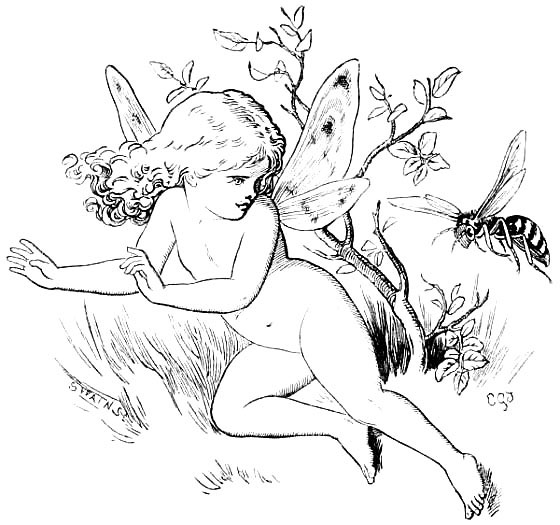
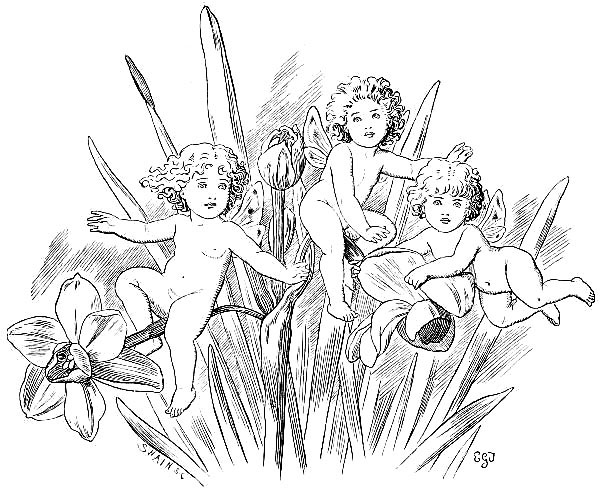
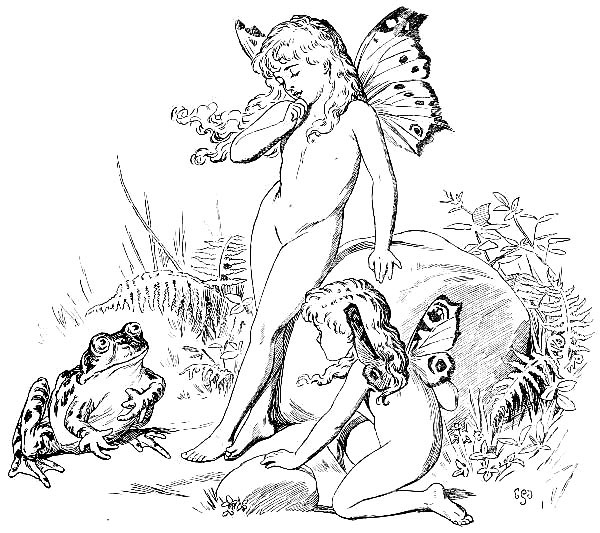
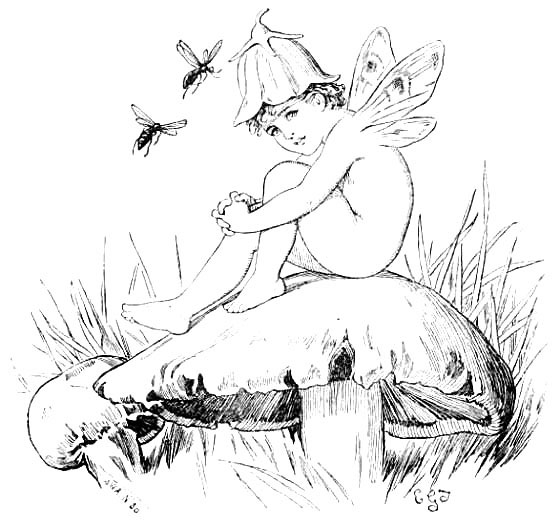
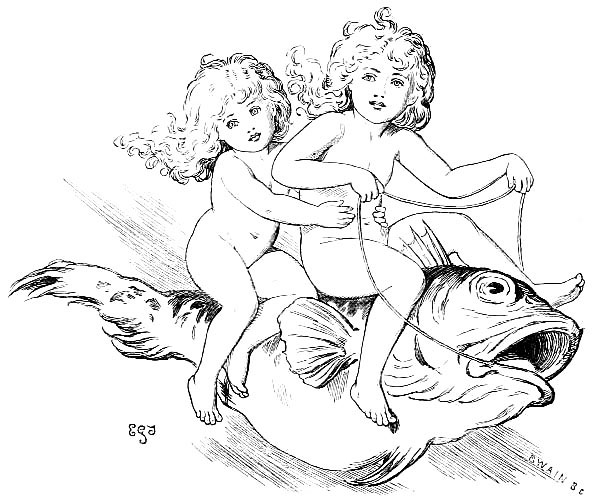
The poetry collection Three Sunsets was illustrated by artist Gertrude Thomson with faery figures, what Dodgson termed “fairy-fancies,” as illustrated throughout this post. Previously, I have described how Dodgson chose her for the commission because he had been impressed by her illustrations for William Allingham’s poem ‘The Fairies’ and by some Christmas card designs in 1878; on this basis he referred to her as the “young lady who knew fairies…” Nonetheless, this is exactly how the author appeared to the children whom he befriended and photographed: one of his models, Dymphna Ellis, many years later remembered that “His traffic with the fairies seemed a very definite thing to us then.”

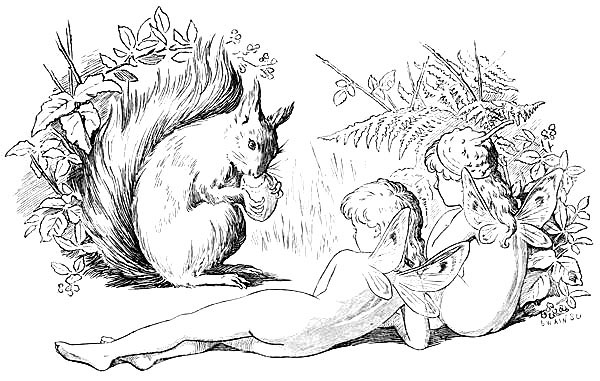
As will be seen, Thomson’s faeries are very tiny children, an artistic (as well as poetic) convention of the day- and still, of course, prevalent, having evolved steadily through the work of Arthur Rackham and the later Flower Fairies. Another example of this idea comes from the children’s illustrator Kate Greenaway who, when challenged by the art critic John Ruskin to show him “what fairies were like” replied “they’ll be very like children.” This takes us right back again to our earlier discussion: Gertrude Thomson became a kind of drawing tutor to Dodgson and they often worked together on life studies of girls. In August 1897 she suggested to him that he might visit the seaside to find children playing on the beach whom he could sketch and, in his reply, he referred to these potential models as “live fairies.” For many Victorians, there was little to choose between fairies and naked children running around, playing on the sand. As you’ll see from Thomson’s illustrations, both here and in my previous post, she was not at all consistent about adding wings. When they’re present, we’re plainly looking at a faery, but tininess alone will do (note that the right hand fae below is wearing an acorn cup on her head and the faery boy on the toadstool shown above has made a hat from a flower).

The delicacy of wearing flowers indicates another intrinsic assumption about these dainty, be-winged faeries. Reducing them all to the size of infants (or smaller) led to a corollary: if they looked like children, they had to be as harmless as children. Whilst a faery might have been subject to the occasional tantrum, the prevailing view was that they were uniformly sweet-natured and gentle. We see this implied by their easy familiarity with woodland creatures, their affinity with flowers and a lifestyle of play. The faery of authentic British tradition- who is often untrustworthy, self-serving and vicious (if not positively dangerous)- was concealed by these misleadingly benign images. Once, the point of stories about faeries was to warn children about the perils of faery-kind; they became, instead, mere amusement. In the illustrations for Three Sunsets, Thomson and Carroll are clear culprits, but far from the only ones. These verses notwithstanding, it has to be observed that Carroll- for all his playful humour- was prepared to show a more adult and threatening world to his junior audience: ‘Malice in Wonderland’ is a pun on his first book very commonly used, but it is by no means an unjust description of the world he invented. Alice is constantly faced with danger- such a drowning and beheading- in a confusing place full of anger, jealousy and violence. Humpty Dumpty falls from the wall and is smashed: child readers were not protected from the harsh realities of life. Carroll understood that there was a ‘darker side to faery.’

For more about Victorian faery verse, see my book on the subject; for more on Charles Dodgson/ Lewis Carroll, my study of the Alice works and their cultural impact is relevant.

‘They called them the demon dogs’- the Cwn Annwn, Welsh Hounds of Hell

In the Welsh collection of stories known at the Mabinogion, the ‘first branch’ of the stories concerns Pwyll, prince of Dyfed. He goes out hunting one day and comes across a pack of hounds feeding on a downed stag. Pwyll drives this pack off so that his own dogs can eat. This is a grave mistake, as these hounds belong to Arawn, lord of Annwn (or Annwfn), which is the Cymric underworld, and Pwyll’s intervention attracts this dangerous lord’s enmity. Arguably, the prince ought to have known not to interfere, as the dogs which are white with red ears- are clear examples of supernatural beasts (Scottish faery cattle, for example, have the same colouring). The Mabinogion is of early medieval origin, but elements of its stories are still current. So, in more recent Welsh tradition, there just two hounds in Arawn’s pack; they are very small and have become sometimes white, but sometimes black and ugly with flame-red eyes, sometimes liver-coloured or, worst of all the types, blood-red, dripping with gore and with eyes like fireballs. In this respect, they seem to have shifted away from dogs owned by faeries to ‘faery beasts’- that is, supernatural hounds akin to the Black Dogs of English folk tradition.

In the county of Cardiganshire (Ceredigion), the cwn was headless and was sighted as recently as 1880. In Cwm Cerwyn, near Aberystwyth, and further south in the Preseli Hills, it was reported in 1897-98 that the hounds, here called the Cwn y bendith y mammau (the faery dogs) were still to be heard from time to time, though not as often as in the past.

Interestingly, a writer in The Welshman in May 1905 noted that, whilst one hears of the cwn y bendith y mamau, the term cwn tylwyth teg is never encountered. Although tylwyth teg and bendith y mamau are generally treated as interchangeable Welsh names for the faery folk, the writer speculated whether this in anomaly of labelling revealed that- in the past- a subtle difference between the faery families had been recognised by the population, a faerylore detail now lost to us. He suggested that the bendith y mamau might have “had more of a native Welsh character,” whereas the tylwyth teg “corresponded pretty nearly to the Korrigans of Brittany, and the ‘Good People’ of Ireland.”

As for these dogs, also called the cwn annwn– ‘hell hounds’ (or cwn cryff– corpse dogs), they may have appeared first in the Mabinogion, but they have been recorded continually in Welsh folklore right up to the present day. The sound of the barking of the hounds is widely regarded as a sign that some soul is being seized at the very moment of death and will be taken to hell. In some instances, a female spirit called Mallt y nos is seen with the dogs, rather than Arawn himself as one might expect. She is said to be a Norman woman, ‘Matilda of the Night,’ a huge hag who was cursed to go with them after declaring whilst alive that she wished she could hunt rather than go to heaven after her death.

One writer traced the cwn annwn back to the Roman occupation of Wales, and proposed that the Romans had identified certain native deities with their own Pluto, the Greek god Hades. Arawn, therefore, was the “Hades of Druidic lore.” Curiously, modern tradition has reported that they were most active on Christmas Eve and on the nights before other religious festivals- apparently functioning as a strange kind of curse upon those who died at these holier times of the year. In Radnorshire, however, it was said that they were most often heard during the Spring; elsewhere in Wales people believed that they were best heard on wild and stormy nights.

Another species of supernatural hound is the Cwn Wybir (or Wybr)- the dogs of the sky- which are plainly related to Arawn’s hounds of hell: they are believed to be evil spirits in canine form and in sightings are often accompanied by flames. Usually it is the fire, rather than the hounds themselves, that’s seen, trailing behind them across the sky like the chains that are so often associated with the black hounds of English tradition. Their passage through the heavens has been described as resembling a “jostling comet” and (like the cwn annwn) it is inseparable from the sound of their chilling barks and yells. The cwn wybir are- as is the case with so many faery apparitions- a premonition of the death of a person known or related to the individual who sees them. Terrifying as they may look, and fatal as their message may be, they do no harm to mortals.

There is too the Ci-Bal, a huge rushing hound that ranges across all of south Wales. He hunts out those who are alone in deserted places at night; their only chance of escape is to cross running water. Fortunately, very few have encountered him and those that have were so terrified that they could never bring themselves to describe the nightmare experience afterwards. Related to the Ci-Bal is the gwyllgi, another spectral dog known in the Vale of Glamorgan (the name may literally be translated as ‘twilight’ or ‘gloom’ dog). One was known near a place called Mousehead, which would appear in the lanes thereabouts at night and terrify horses and their riders. The gwyllgi was also found at Aberffraw on Ynys Mon (Anglesey) where it ranged along the cliffs and seashore. As one story published in the Cardiff Times in November 1899 described, “Fear him not, fair mistress, for his form is uglier than his nature. Hadst thou heard the Cwn Annwn, it had been different.” These dog-spectres scare, but they don’t steal souls.

The intertwining of ideas about faeries and the reports of the ‘hounds of hell’ will be very obvious. Another sign of this tangled mythology relates to another name for the tylwyth teg. Fascinatingly, the name Plant Annwn, the ‘Children of Annwn,’ is another epithet used for the faeries; they have been called, as well, ‘wandering spirits’ and ‘children of mystery,’ and are the subjects of the faery king Gwyn ap Nudd (and Gywn and Arawn clearly are rivals for or successive occupants of the faery throne- as, for that matter, is Rhys Dwfn).

The exact relationship of Faery to the dead, and to the ‘land of the dead’ or to Hell, and their interactions with the living, is a subject that has puzzled and confused mortal kind for centuries. The stories of the ‘hounds of hell’ demonstrate and complicate these links, without clarifying matters much. Christian tradition, and the notion of souls going to either heaven or hell, have long been bound up with these accounts as well, further compounding the uncertainty. In English tradition we find Dando and his Dogs and the Gabriel Ratchets, as examples of the ‘wild hunt’ of souls, but there are also the Black Dogs of the eastern counties which have the same functions of predicting death or disease, or simply of harassing individuals in the dark, but which have not been given any sort of ‘religious’ role. Perhaps this is a glimpse of an older, more original and less corrupted tradition, dating to a time before people felt the urge to reconcile faery lore with church teachings.

I’ll conclude with a final Welsh example, which again ties the tylwyth teg to the land of the dead and ghastly horrors; it’s full of macabre imagery, albeit without elucidating matters much further. One commentator ( ‘Gleanings by Death-Besides of a Rural Doctor,’ Cambrian Quarterly Magazine & Celtic Repertory, no.17, Jan. 1833, 51 ) described the gwyllion (ghosts, spirits, night wanderers) and ellyllon as being like terrible pygmies, “goggle eyes in heads without bodies” that lay on the ground like corpses in their thousands, or rose up to terrify the witness face to face. They appeared to him “thick as mites, one after the other, and a great bloody tear hung in every eye, whilst it looked into mine as if it would flash into my brain.” He claimed that the ellyllon (or elves) were born from worms that emerge from holes and grew into dwarves and then to devilish human-like beings. It’s a superbly Gothic and macabre account, although it really only muddies the waters in terms of defining faery nature by so compounding them with ghosts, ghouls and avenging demons.

Cwn wybr by Manchester artist Katy Jones (see too her Etsy store)

We Went to Gwent

Harold’s Stones, Trellech

A few days away near Monmouth included the usual holy well hunting and a visit to some standing stones. At the village of Trellech just south of Monmouth, there is an alignment of three very tall menhirs (the ‘three stones’ that give the village its Welsh name) which I’d wanted to see for some time. These are called Harold’s Stones, allegedly marking a battle fought by the last Saxon king, but they’re very obviously far older than the 1060s.

Nearby too were the remains of a Norman motte and bailey castle and, more importantly, the so-called ‘Virtuous Well.’ This was one of nine healing springs once recognised in the area (and commemorated in the name of Ninewells Wood), each of them treating a different condition.

This well was once called St Anne’s Well- although it has been suggested that this is, in fact, a Christianised version of Annis’ Well, an ancient name that is now primarily associated with the supernatural ‘hag‘ Black Annis known in the East Midlands. Today, the well no longer has a saint’s dedication, but its properties are still celebrated because it has the power to cure eye complaints and (as the sign quaintly put it) “the problems peculiar to women.” I duly bathed my eyes- and will report back on any improvements. Faery wells linked to sight are not unknown elsewhere- a good example being the ‘Fairy Well’ between Hardhorn and Staining near Blackpool on the Lancashire coast. The water of this well was also known to treat weak eyes.  A mother whose daughter’s eyesight seemed to be failing went to the well to fill a bottle.  There she met a “small green man” who gave her some ointment to apply to the child.  Before treating her daughter, the cautious mother decided to test the salve on herself first; she put it her own eye without ill-effect and therefore applied it to the girl, who was cured.  So far, so good- but there is a familiar conclusion.  Sometime later, however, the mother saw the same little man at the market.  She thanked him for the cure; but he was angry and demanded to know with which eye she saw him.  She told him and was promptly blinded, as happens in all such stories of midwives and wet nurses.  It appears, therefore, that her offence was to apply the ointment to someone other than the person for whom it was intended

The Virtuous Well at Trellech also possesses predictive powers, and young women used to visit discover how long it would be until they married by dropping pebbles into the water: the number of bubbles which rose from the spring indicated the length of the wait; this idea is quite common around Britain and the number of bubbles, or stillness of the water, may also indicate whether a cure will be granted. The way the water responded is, once again, far from uncommon in British tradition. At Killiemorie Well in the Scottish parish of Kirkholme, if the water rose, it was a sign that the patient would recover, whereas at Muntluck if the water level was low- or it was dry- it was a sign that the disease would prove fatal. In other recorded cases from Scotland, selected stones were heated and then left over night. If, when they were put in water the next day, they made a noise (they “chirme and chirle into the water”) a diagnosis could be made. The faery presence seems to render the water magically responsive in some way.

As may be made out from the photo, “clooties” (rags) are still tied to the elder and hazel trees growing over the well. These would be attached to ‘seal’ the request to the spirit of place. Similar offerings are to be seen at Aberfoyle and at Madron Well in Cornwall.

A local story relates how a farmer once very unwisely destroyed a faery ring near the well, but faery vengeance soon assured that he reinstated the turf he had removed. He discovered that whenever he tried to draw water from the well it would be dry (a problem no one else was experiencing) and a meeting with a “strange little old man” then made the source of his problems clear.

This small man’s identity becomes apparent when we learn that the tylwyth teg are said to dance at the well on Midsummer Eve, drinking water from harebell flowers, which are then found scattered around the site every Midsummer morning. Local people used to collect and dry these, using them as a medicine if a person was ill. Another version of the story states that Halloween was the time when the dancing took place- and I don’t see why both festivals were not marked by the Fair Folk at the site.

As you’ll see below a visit to Caldicot castle followed: promises, promises…

The Green Lady of Caerphilly- and other faery women

In June 1901 a Mr John Griffiths wrote an article in the Pontypridd Chronicle and Workman’s News in which he recounted aspects of the story of the mysterious green lady of Caerphilly/ Caerfili Castle. He began by noting that “Perhaps there is hardly corner of Wales where the Ladi Wen (The White Lady) has not been seen.” Green ladies were less common, but were known in Wales and were also very ancient. I’ll immediately observe that, whilst green is the typical faery colour in Britain, the Welsh faeries (the tylwyth teg) are notable for the fact that they not only wear white but may be entirely white– their skin, hair and even their eyes. It’s also worth adding that there can be some ambiguity as to whether colour adjectives, when applied to the fae, refer merely to their clothes or, in fact, are descriptive of their flesh and hair- a distinct possibility, but far more alarming, as well as being a profound challenge to our conventional perceptions of them.

The key elements of the Caerfili story, as told by Mr Griffiths, were as follows: the Green Lady haunted the castle as a portent of doom, but she was known regularly to leave the ruins and travel around the neighbouring region. One of her favourite locations was the Mawn Du (Black Bog) on the Eglwysilan Mountain (near Pontypridd), where- once a year- she would take up residence for a time- although a retinue of messengers maintained communication between the castle and the Lady during her absence. Whilst in the mountains, her habit was to walk around the black peat bogs, dipping occasionally into them and re-appearing on the surface “as green as ever” (it’s not clear whether the author here meant that the water failed to wash her, to stain her with mud or it renewed her virid hue). So, Griffiths concluded, apart from the hauntings and premonitory appearances of the lady at Caerfili castle, there were a number of folklore elements to her story which connect the Green Lady with the wider family of the Welsh fairies, her green colour being just one of them.

Griffiths then included a song about the tylwyth teg as a whole, which combines many of the facets of his description of the green lady: her foreknowledge, her liking for bare moorland, her watery abode- like the well-known lake maidens (gwragedd annwn) of Welsh folklore, her nocturnal habits and- of course- the faery love of singing and dancing, leaving rings on the turf:

Os bydd rhywbetb yn eich blino/ Canwch gan y tylwyth teg; Os gofynwch beth yw hono/ Gwybod gewch yn union ieg. Llawen ganu gyda’u gilydd/ Draw o gyrhaedd poen a chlwy. Ganol nos ar gefn y mynydd/ Dyma fel y canant hwy: Canwn yn llawen ar hyd y nos, Cysgwn yn drwm y dydd, Ni ddaw un cylch ar waen a rhos, Na gair, na meddwl prudd.

“If something bothers you, Sing with the fairies; If you ask what it is, you will discover exactly. Joyful singing together, Away from the reach of pain and sickness. In the middle of the night on the back of the mountain, This is what they sing: ‘We sing joyfully all night, We sleep heavily during the day, Not a single circle will come on meadow and heath, No word, no sombre thought’.”

Griffiths concluded that “the Welsh fairies, as a rule, are very loveable little things, [especially] compared with the Saxon imps.” This statement may be an overly favourable and patriotic view of the tylwyth teg, who were just as capable of vengeance and cruelty as any other faery family (and I’d advise against referring to our Good Neighbours in such patronising terms!); moreover, the Green Lady, when she left the castle and took to the ”waen a rhos” (gwaun- meadow and rhos– heath), seems definitely to have displayed less friendly habits. Many nocturnal travellers over this barren upland had similar scary encounters with her: she liked to play Jack o’ Lantern amidst the bogs, acting like a will of the wisp to lead people astray.

As Griffiths had observed, white supernatural ladies appeared to be more common in Wales than green, but this was not the case in wider British tradition. To demonstrate this, he made a comparison with a green faery lady known in Scotland, who would appear wearing the old Welsh sugar-loaf hat and wearing green garments. This cousin of the Caerfili woman was described as follows:

“She was dressed in green, all but a short white apron and a black velvet hood, and a steeple-crowned beaver hat on her head. She had a long walking staff, as long as herself, in her hand- the sort of staff that old men and women helped themselves with long ago; [but] I see no such staffs now.”

As I’ve observed before, wearing antique styles of clothing is something of an identifying trait for the faeries. This Scottish figure has something in common too with the ‘Old Woman of the Mountain’ described by Wirt Sikes in his study of Welsh faerylore, British Goblins. He describes her in the following terms:

“The Old Woman of the Mountain typifies all her kind. She… haunted Llanhiddel Mountain in Monmouthshire. This was the semblance of a poor old woman, with an oblong four-cornered hat, ash-coloured clothes, her apron thrown across her shoulder, with a pot or wooden can in her hand, such as poor people carry to fetch milk with, always going before the spectator… (page 49).”

Furthermore, this northern Green Lady was very fond of visiting not only certain favourite haunts, but more particularly the housewives of the countryside. She would appear to women suffering in labour, offering to act as midwife, but her appearance at their time of need was far from disinterested. She would undertake to help deliver their babies and to save them- but only subject to a very hard condition. She claimed as her reward the possession of the woman’s baby. It’s true that Queen Mab is known as the faery midwife, but the abduction of mortal children is a much more typical faery trait.

Other faery women who dressed in green in Scotland are known (like the Caerfili lady) to haunt bodies of water and to attack passers-by, such as on the River Conan and by the Lynn Burn at Lynturk. There are many more- the prophetic Perthshire faery washer woman, the bean nighe, is seen in green, as is the caointeach or ‘keener’ of the Western Isles; the banshee (bean sith) of Lich Migdal has been seen sitting on a rock near the lake in a green silk dress; the female Highland ‘brownies,’ the glaistigs and gruagachs, also appear this way. The fierce and dreadful baobhan sith of the Highlands may appear as a crow or raven- or as a lovely girl in a long green dress. Hugh Miller described how, in the north eastern counties of Scotland, a green woman, with a ‘goblin child,’ would go from cottage to cottage at night, bathing her infant in the blood of the youngest human child.  Yet another ‘green lady’ used to go house to house spreading small pox.  Evidently, the Scottish green faery woman is commonly fatal to encounter and is particularly malevolent towards children- a far more dangerous prospect than her Welsh relative.

Now, describing South Wales folklore in volume 36 of the Reports & Transactions of Cardiff Naturalists Society for January 1903, a Mr T. H. Thomas recorded that Welsh ‘goblins’ would take on two forms, one being a “beautiful aspect, with sexual allurements” and the other a hideous, devilish form which “tempts wayfarers into dangerous places and abysses.” As an example of the first, he recounted a Pontypool story he had heard as a child; it is an account with clear echoes of the Highland baobhan sith just mentioned. The boyfriend of Mary Watts was out at night, walking to the place where the couple had agreed to meet. He heard footsteps behind him and a young girl with veiled head caught up with him and walked by his side. She suggested they go together to the fair in town, where they could dance together all night. The man declined, but she twined herself around him and tried to drag him off the path, in response to which he exclaimed “By God, I will not come!” These words acted as a charm that broke her spell- he pulled off the veil and saw her pretty face change to a repulsive one as, lit by blue flame, she vanished.

The second, ‘devilish’ form of Welsh goblins is always unsightly, Mr Thomas recorded, being a hag like the ‘Old Woman of the Mountain’ or else the (male) pwcca, both of whom (as we’ve seen) will act somewhat like a will of the wisp and try to entice travellers over cliffs. What Mr Thomas recorded here obviously confirms what Mr Griffiths wrote and serves to tie the Green Lady of Caerfili into wider Welsh tradition on malign faeries and ‘hags.’

Finally, Griffith speculated why the Green Lady would sometimes depart from Caerfili castle. It was not, he suggested, voluntary. The Scottish Green Lady in the tall hat whom he described was reported to disappear with a thunderous noise and a terrific shriek whenever a mortal pronounced her name. Despite her efforts to guard her identity, it was known that this individual was called ‘Whuppity Stoorie,’ he reported. In England her equivalents are known as Marget Tot and Trit-a-Trot; in Wales, her most common names are Sili go Dwt and Trwtyn-Tratyn. In Monmouthshire, according to Craigfryn Hughes (interviewed by John Rhys, Celtic Folklore, 593), a male plays a similar role, and his name is Gwarwyn-a-throt.

Returning to Griffith’s speculation about her possible name, the Caerfili Green Lady is anonymous- that is, she’s managed to keep her magically potent sobriquet secret. Whatever she may be called, it’s very likely that it would be hard to guess because its form would be completely unfamiliar to us (which is why, in the folklore, faeries can only be defeated by accidentally and very carelessly revealing their names). Writing about ‘Ancient Wales- Archaeological Evidences’ in the Transactions of the Honourable Society of Cymmrodorion in January 1917, J. B. Fleure observed that, as far as faery language is concerned, “often the fairies have what seem to be nonsense names, such as Sili-Go-Dwt, and this may indicate some difference of speech [from humans].” However, he added that it was perhaps not such a fundamental difference that it created insurmountable problems of comprehension, seeing as he did not feel that its alien and unintelligible nature was particularly stressed in the sources (page 131). Nevertheless, he seemed to accept that the faeries spoke neither Welsh, nor English, although it may have been a tongue not wholly unrelated to both (see my Spirits of the Land for more on this issue). Interestingly, Fleure also noted that the teg element of tylwyth teg denotes fair weather or fair dealing, as opposed to fair haired, and reports of changelings tend to describe them as “dark and even wizened.”

In conclusion, the Green Lady of Caerfili castle is part of a rich and vast tradition, within Wales and across Britain. She has various aspects- a predictive ability which faeries often display- but also a malicious or vindictive side to her character which takes pleasure in harming strangers. She could perhaps shape shift, she liked to be near to water, and she was careful to keep her name concealed, for to reveal it to a human was to risk being in that person’s power.

Gnomes Without Frontiers- Puck & the Pwcca

A sketch of a pwcca as seen by one witness

We tend to think of Puck as a quintessentially English spirit- thanks to Shakespeare’s Midsummer Night’s Dream– but he is far better regarded as a British sprite. Shakespeare was a Warwickshire native, with some knowledge of the traditions of the Border counties, but this familiarity that was greatly strengthened through his friendship with Richard Price, a clergyman of Breconshire. It seems that visits to the Prices’ homes in Brecon and Merthyr Tydfil may have enhanced the playwright’s awareness of Welsh folklore traditions- and that this fed into his work. Another (or parallel) Welsh source for the authentic stories that appear in the plays has been proposed to have been through the family of the poet Henry Vaughan (1621-95), who lived at Scethrog Castle (south-east of Brecon on the road to Crickhowell).

English Puck, once he has crossed the border, becomes Pwcca (a name that ‘mutates’ to Bwcca according to context). As Maria Jane Williams of Aberpergwm, in the Neath valley, wrote to folklorist Crofton Croker in July 1827, this “goblin” Pwcca, Bwcci, or even Brocci, was known widely in Wales, but most especially in Breconshire, where Cwm Pwcca (Puck’s Valley) formed part of the Vale of Clydach near Merthyr. That town, however, had lately become a centre for iron making in South Wales and Ms Williams suggested that the “bustle of business had scared [the pucks] away,” although they were not gone entirely; they would still occasionally play their old tricks, behaving like wills of the wisp and leading people astray (as Wirt Sikes was later to record in his British Goblins, 1880, pages 22-24). Interestingly, Cwm Pwcca, or Cwm Pooky, used to be owned by the Vaughan family, further strengthening the possibility that Shakespeare heard stories about the sprite from them rather than the Prices.

A little further south, in Monmouthshire, the Pwcca Trwyn (or Pwca ‘r Trwyn) was still well known at the same period and, indeed, the origins of stories about him seem to date back four centuries from then to around 1450. On the whole, he performed the function of the English and Scottish brownie, faithfully serving farmers and householders by doing hedging work, feeding the cattle in wet weather and cleaning out their byres. As with his brownie cousins, the pwcca trwyn was offered food in thanks and, if this was forgotten, he would show his pleasure causing havoc in the dairy- or perhaps throwing stones at his victim. However, an overly righteous person once decided that it was unchristian for god-fearing folk to rely upon such help, and he laid the spirit, a fact much regretted locally. This banishment was said, in 1850, to have been for three generations and was fervently hoped soon to be over- which implies that the Pwcca Trwyn may have been expelled sometime around 1775.

The Monmouth Pwcca was seldom seen or heard, although tools he was using in his work might be glimpsed moving, seemingly of their own accord. In the farmhouse, he inhabited the oven and very occasionally spoke from there (and even more rarely, touched family members). If he was spotted, it was still only in the form of a wisp of loose dry grass rolling before the wind- an ideal guise for passing unnoticed by mortals (see Notes & Queries, vol.2, 1850, 389); one story tells that the pwca left one farm and travelled to another in the shape of a ball of yarn, which must surely be related. A second account describes how he was carried by a maidservant in a jug of barm (fermenting malt liquor). This incident must remind us of Shakespeare’s Puck who will sometimes “lurk in a gossip’s bowl, In very likeness of a roasted crab, And when she drinks, against her lips I bob” (Dream, Act 2, scene 1).

As may be appreciated, Pwcca was a spirit of the southern part of Wales; hence in the area now called Gwent (the south east) it was once said that, around Halloween, there was a “pwca ar bob camfa” (a puck on every stile), an aphorism that confirms his ubiquity.

The pwcca is also more embedded in British culture than we might appreciate. Not only was he so common in folklore that he was taken up by Shakespeare and became globally famed, but he also found his place in our language. According to one etymology, the phrase hocus pocus may be derived from him: the phrase could be a combination of Welsh hoced (a cheat or trick) and pwcca/ bwcca/ bwg– a ‘Puck’s Trick,’ perhaps. It would not be inappropriate if it was correct.